Total Project Transparency With AI: A New Standard for Delivery

For years, project transparency meant dashboards, weekly reports, and slide decks carefully assembled before steering meetings. Information moved upward in controlled summaries. Risks were filtered. Status was interpreted. 

AI is changing that model. 

Instead of asking, “What happened last week?” organizations can now ask, “What is happening right now?” More importantly, they can ask, “What is likely to happen next?” 

This shift is moving project delivery toward something more ambitious than visibility. It is moving toward total project transparency. 

And platforms like Twinsights are pushing that shift from theory into operational reality. 

What Total Transparency Actually Means 

Transparency is often confused with more reporting. In practice, it means less manual reporting and more shared truth. 

AI-powered transparency connects live data across tools, workflows, and teams. It draws from task systems, financial platforms, communications, risk logs, and delivery milestones to build a continuous view of performance. 

Most modern tools have introduced AI features that summarize progress or forecast timelines. But aggregation alone is not enough. 

True transparency requires orchestration. 

This is where a centralized intelligence layer becomes critical. 

The Role of Twinsights Command Centre 

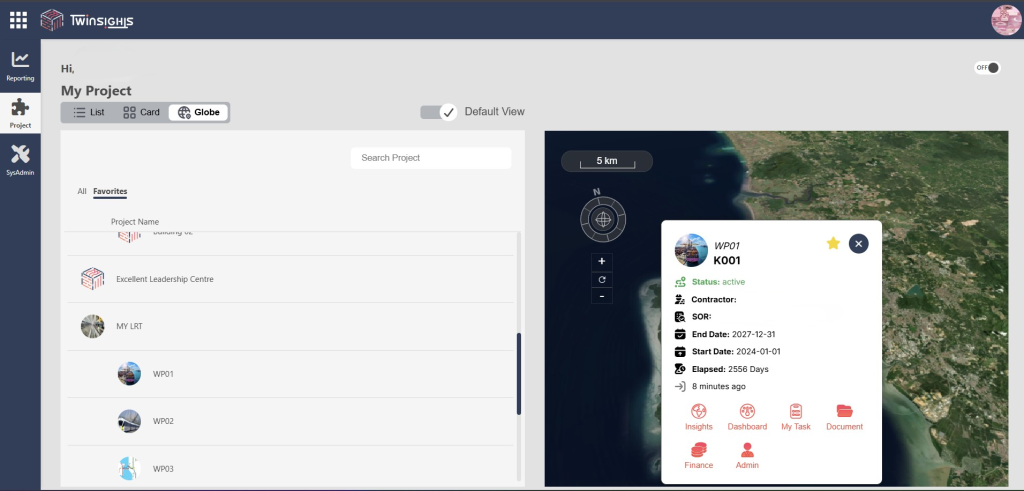
Twinsights Command Centre model goes beyond dashboards. It acts as a live operational nerve center. 

Twinsights Command Centre is a single source of delivery truth across complex infrastructure projects. Instead of forcing leaders to jump between systems, it consolidates signals into one continuous performance view. 

The value is not just consolidation. It is interpretation. 

For example: 

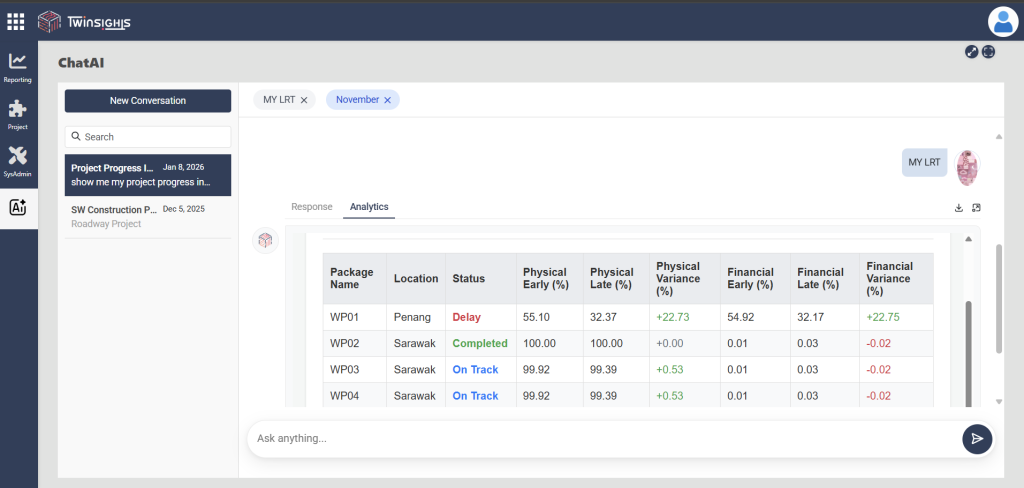
  • It can flag emerging schedule slippage before a milestone is missed. 
  • It can detect workload imbalance across teams. 
  • It can highlight risk clustering across related projects. 
  • It can surface dependencies that are likely to cascade delays. 

Rather than waiting for a red status report, leadership sees leading indicators in real time. 

The Command Centre model shifts projects from reactive to predictive. 

From Lagging Indicators to Leading Signals 

Traditional project reporting focuses on lagging indicators. A missed deadline, an exceeded budget, a failed sprint. By the time these are visible, intervention is costly. 

AI enables the detection of patterns that precede failure. 

For instance: 

  • A gradual drop in task completion velocity 
  • Increased change requests late in delivery cycles 
  • Declining testing coverage 
  • Communication bottlenecks between departments 

These patterns are often invisible when looking at one project in isolation. They become clearer when analyzed across portfolios. 

A Command Centre amplifies this capability by correlating signals across multiple initiatives simultaneously. That broader lens is what creates strategic transparency. 

In large-scale environments, similar predictive discipline has long existed in mission-critical settings such as NASA programs, where early anomaly detection is standard practice. AI now brings comparable foresight into enterprise project delivery. 

Eliminating Status Theater 

Anyone who has sat through executive updates knows the dynamic. Projects are green until they are suddenly not. Risks are softened. Forecasts are optimistic. 

Often this is not deception. It is fragmentation. Data lives in different systems. Managers rely on partial information. Human bias fills the gaps. 

A Command Centre reduces subjectivity. 

When progress metrics are derived directly from operational systems, narrative distortion becomes harder. If resource capacity is consistently overextended, the system reflects it. If dependency risk is rising, it is visible before it becomes critical. 

This does not remove human judgment. It grounds discussion in shared data. 

Instead of debating whose version of reality is accurate, teams debate solutions. 

Cultural Implications: Transparency vs Surveillance 

Total transparency sounds powerful. It can also feel threatening. 

AI systems that analyze workflow patterns or communication trends may raise concerns about surveillance. Without careful governance, transparency can be misinterpreted as control. 

Successful Command Centre implementations share three characteristics: 

  1. Clarity of intent 

The purpose is improved delivery, not performance policing. 

  1. Shared visibility 

Insights are accessible across levels, not restricted to senior leadership. 

  1. Actionable follow-through 

Flagged risks lead to support, not punishment. 

When transparency leads to earlier assistance rather than blame, adoption accelerates. 

Technology alone does not create trust. Leadership behavior does. 

Portfolio-Level Intelligence 

One of the most significant shifts AI enables is portfolio-level intelligence. 

In many organizations, each project operates as a silo. Even if individual projects are well-managed, systemic risk remains invisible. 

Twinsights Command Centre provides: 

  • Unified view across operations 
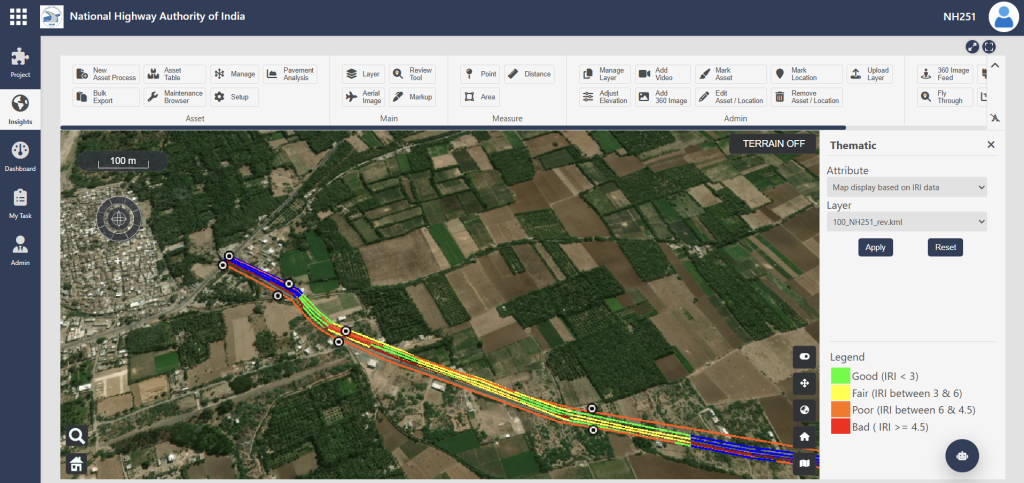
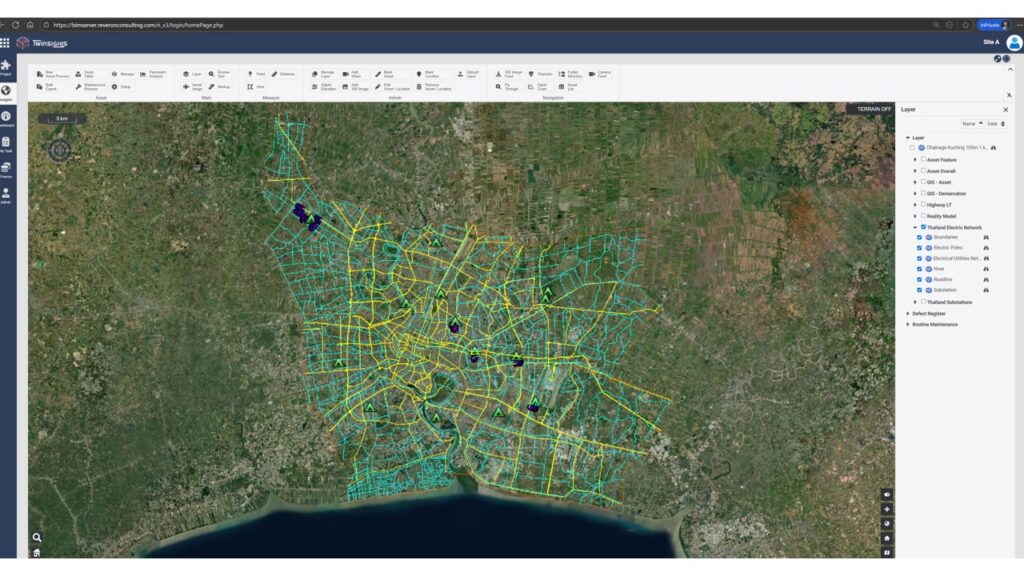
  • Geospatial Intelligence 
  • Asset oversight and compliance visibility 
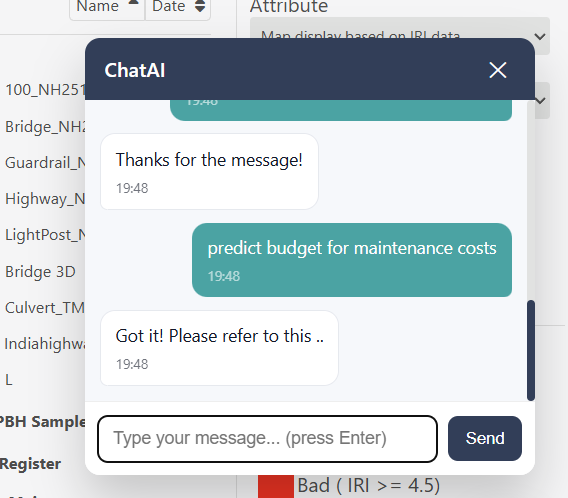
  • AI-powered chat with contextual insights 

Without an AI-driven consolidation layer, these complex infrastructure projects often require manual reconciliation across departments. 

With AI, they can be accessed on demand. 

Benefits Beyond Reporting 

The operational benefits of AI-driven transparency extend well beyond cleaner dashboards. 

Earlier risk intervention 

Predictive signals allow corrective action before deadlines are missed. 

Reduced administrative burden 

Automated summaries eliminate hours spent preparing status updates. 

Improved executive alignment 

When everyone sees the same real-time data, strategic decisions move faster. 

Stronger client confidence 

Transparent, data-backed reporting builds credibility with external stakeholders. 

In high-complexity industries such as infrastructure, technology transformation, and defense contracting, these benefits directly impact profitability and reputation. 

The Limits of “Total” 

Despite its promise, total transparency has practical limits. 

AI systems depend on clean, integrated data. Poor data hygiene produces misleading insights. Tool fragmentation can still create blind spots. Predictive models provide probabilities, not guarantees. 

Ethical governance also matters. Organizations must define boundaries around data usage, especially when analyzing communication or productivity signals. 

Transparency must be balanced with privacy. 

The most mature implementations treat AI insights as decision support, not decision replacement. 

Is This the New Standard? 

The direction is clear. AI capabilities are becoming embedded across delivery platforms. Executives increasingly expect real-time forecasting rather than static reports. Clients demand predictable outcomes in volatile environments. 

As more organizations adopt Command Centre models like Twinsights’, expectations will shift. 

Manual slide decks will feel outdated. Reactive risk management will feel insufficient. Portfolio oversight without AI support will seem incomplete. 

Just as cloud computing redefined infrastructure expectations, AI-powered delivery intelligence is redefining governance expectations. 

The organizations that adapt early gain a compounding advantage in predictability and confidence. 

What Leaders Should Do Now 

Transitioning toward AI-driven transparency does not require an overnight transformation. 

A pragmatic approach includes: 

  • Mapping existing data sources and integration gaps 
  • Piloting Command Centre capabilities within one portfolio 
  • Establishing data governance standards 
  • Defining ethical usage guidelines 
  • Measuring improvements in risk detection and delivery predictability 

The goal is not to pursue technology for its own sake. It is to reduce uncertainty in complex delivery environments. 

Final Thoughts 

Total project transparency with AI represents more than better reporting. It represents a shift in how organizations understand and manage delivery risk. 

Platforms like Twinsights illustrate what happens when data, predictive analytics, and governance converge in one operational view. 

When implemented thoughtfully, AI does not replace project leadership. It strengthens it. It shortens feedback loops. It surfaces hidden risk. It builds shared clarity across teams. 

Whether this becomes the universal standard for delivery depends on culture as much as capability. The tools are ready. The predictive models are improving rapidly. 

The remaining question is simple. 

Are organizations ready to see everything clearly? 

For more updates, follow us on LinkedInTwitterFacebook, and Instagram.

A Smarter Way to Run Infrastructure with the Twinsights Command Centre

Infrastructure operations today demand speed, clarity, and confidence. Yet many teams still rely on disconnected tools, delayed reports, and manual coordination to understand what is happening across projects and assets. As infrastructure networks expand, gaining a clear and reliable operational picture becomes increasingly difficult.

The Twinsights Command Centre is designed to solve this challenge by bringing everything into one unified operational view. It helps teams see clearly, act early, and collaborate better across the entire infrastructure ecosystem.

At a glance, the Twinsights Command Centre brings together:

  • A unified view of all active and upcoming projects
  • Live geospatial awareness with contextual overlays
  • Real-time progress, performance, and compliance tracking
  • End-to-end lifecycle visibility from planning to maintenance
  • Predictive insights to identify risks early
  • AI-powered interaction with operational data

This is not another dashboard. It is a command environment built for real-world infrastructure delivery.

Why Infrastructure Visibility Breaks Down

Infrastructure visibility challenges are rarely caused by a lack of technology. They arise when information is scattered across systems that were never designed to work together. As projects grow in scale and complexity, the gap between on-ground reality and decision-maker visibility continues to widen.

Infrastructure does not lack data. It lacks connection.

Teams typically operate across:

  • Multiple regions, contractors, and partners
  • Separate systems for projects, assets, and GIS
  • Manual reporting cycles and delayed updates
  • Siloed ownership across departments


This fragmentation leads to:

  • Slow and reactive decision-making
  • Risks that surface too late
  • Hidden issues across assets and projects
  • Unclear ownership and accountability

The Twinsights Command Centre addresses this by creating a shared, real-time operational picture that aligns everyone involved.

One Operational View for Every Project

When project data is spread across multiple tools, teams lose valuable time searching for updates instead of responding to what matters. A single operational view brings consistency and alignment, enabling faster and more confident action across all stakeholders.

The Command Centre enables teams to:

  • View all active and upcoming projects in one place
  • Track timelines, milestones, and dependencies with clarity
  • Identify delays and risks early
  • Ensure consistent information across leadership, operations, and field teams

With everyone working from the same shared view of reality, misalignment reduces, and decisions move forward more efficiently.

AI That Understands Operational Reality

Once information is unified, the next challenge is how teams interact with it. Navigating complex systems and layers can slow down even the best operational setups.

The Twinsights Command Centre includes AI-powered interaction designed specifically for infrastructure operations. Unlike generic tools, the AI understands:

  • Maps and geospatial layers
  • Assets and their condition
  • Timelines, workflows, and dependencies
  • Risks and compliance status

Teams can simply ask it to:

  • Highlight delays or risks
  • Switch views and overlays
  • Generate summaries and insights
  • Retrieve inspection and maintenance history

Interaction becomes conversational and intuitive, allowing teams to focus on decisions rather than navigation.

Intelligence That Starts With Location

Infrastructure exists in the physical world, and location provides essential context. Without spatial awareness, data lacks meaning and insight remains incomplete.

The Command Centre embeds geospatial intelligence directly into daily operations, allowing teams to:

  • View projects and assets on live maps
  • Layer satellite imagery, asset data, and IRI layers
  • Apply risk overlays and thematic maps
  • Understand how geography impacts performance and outcomes

Maps become active decision tools rather than static references.

Live Insight Into Progress and Compliance

Periodic reports cannot keep pace with constantly changing operational conditions. Teams need continuous visibility to respond effectively.

With the Command Centre, teams can:

  • Track progress and countdowns in real time
  • Monitor inspections, complaints, and compliance events
  • Detect delays as they emerge
  • Respond quickly to operational issues

Visibility becomes continuous and actionable instead of delayed and reactive.

Managing the Full Infrastructure Lifecycle

Infrastructure performance is shaped by decisions made across its entire lifecycle. When phases are managed in isolation, context is lost and accountability weakens.

The Command Centre supports every stage, including:

  • Planning and execution
  • Construction and commissioning
  • Operations and long-term maintenance

All workflows remain traceable, historical context is preserved, and teams can understand how past decisions influence current performance.

Built for Teams, Not Just Tools

Successful infrastructure delivery depends on coordination across people, not just systems. A shared operational view creates alignment and trust.

The Command Centre supports collaboration by:

  • Providing a common operational picture for all teams
  • Reducing misalignment across functions
  • Improving transparency and accountability
  • Enabling faster, more confident decision-making

When everyone sees the same information, collaboration improves naturally.

Ready to Scale With Growing Complexity

As infrastructure networks expand, operational clarity often declines. Systems that work at small scale struggle under growing data volumes and asset diversity.

The Twinsights Command Centre is designed to:

  • Scale across projects, regions, and asset types
  • Handle increasing data without clutter
  • Remain intuitive as complexity grows

It simplifies operations even as environments become more demanding.

Redefining How Infrastructure Is Managed

Infrastructure intelligence is evolving. The Twinsights Command Centre brings visibility, context, foresight, and interaction into a single operational environment. It enables teams to move faster, anticipate risks, and manage infrastructure with confidence.

This is a new way to see, understand, and run infrastructure.

A Unified Command Environment for Modern Infrastructure

The Twinsights Command Centre brings structure to complexity. By unifying projects, assets, geospatial intelligence, performance tracking, lifecycle management, predictive insights, and AI-powered interaction into one operational view, teams move from fragmented oversight to informed action.

Decisions become faster because context is clear. Risks surface earlier because signals are connected. Collaboration improves when everyone operates from the same shared reality.

As infrastructure networks continue to grow in scale and complexity, the ability to see, understand, and act from a single command environment is no longer optional. It is essential.

Explore how the Twinsights Command Centre can support your infrastructure operations.

How Digital Twin Visualisation Will Shape Projects in 2026 

Digital twins have moved past the hype phase. By 2026, the conversation is no longer about whether organisations should adopt them, but how effectively they can use them. What is changing most is not the availability of data or modelling tools, but how that information is visualised and used by people making decisions. 

Digital twin visualisation is moving from a specialist function to a shared, everyday project tool. It allows teams to see systems as they really behave, understand problems in context, and test decisions before they are made in the real world. As projects face increasing complexity, tighter budgets, and greater risk exposure, this shift is reshaping how work gets done. 

Why Visualisation Is the Missing Link in Digital Twins 

At its core, a digital twin is a combination of data, models, and logic that represents a physical asset or system. On its own, that information can be overwhelming. Sensors generate continuous streams of data. Simulation models produce complex outputs. Schedules, cost plans, and maintenance records sit in separate systems. 

Visualisation connects all of this into a single, understandable view. 

By 2026, effective digital twin visualisation is what separates useful twins from underused ones. Instead of forcing people to interpret spreadsheets or dashboards in isolation, visual twins show what is happening, where it is happening, and how different factors influence each other. 

This matters because most project decisions are made under time pressure. Clear visual context allows teams to understand issues quickly and respond with confidence. 

Moving Beyond Design and Into Daily Operations 

Digital twins first gained traction in design and engineering. They were used to validate geometry, check clashes, and test layouts. While those uses remain important, visualisation in 2026 extends far beyond the design phase. 

Projects increasingly rely on digital twins throughout construction, commissioning, and operations. Visualisation supports this by showing how assets evolve over time, not just how they look on day one. 

For example: 

  • Construction teams can compare planned versus actual progress in a visual timeline. 
  • Operators can see performance trends mapped directly onto equipment or facilities. 
  • Asset owners can understand how early design decisions affect long-term maintenance and operating costs. 

This continuous visual feedback helps prevent the common disconnect between design intent and operational reality. 

Real-Time Awareness Changes Project Control 

One of the most significant developments shaping projects in 2026 is real-time digital twin visualisation. 

Sensors, automation systems, drones, and site scanning technologies constantly update the digital twin. Visual interfaces turn these live data feeds into dynamic representations of current conditions. 

This transforms project control in practical ways: 

  • Issues are identified earlier, often before they escalate into delays or failures. 
  • Site conditions, safety risks, and quality concerns are visible as they emerge. 
  • Decisions are based on current reality rather than outdated reports. 

Instead of managing by exception after problems occur, teams manage by insight as conditions change. 

Visualisation Enables Better Problem Solving 

Projects rarely fail because of a lack of data. They fail because problems are misunderstood, ignored, or identified too late. 

Digital twin visualisation addresses this by making problems visible and contextual. 

By 2026, teams routinely use visual twins to: 

  • Trace the root cause of recurring equipment issues 
  • Identify process bottlenecks in manufacturing or logistics 
  • Understand how changes in one area affect the wider system 
  • Evaluate safety risks under different operating conditions 

When problems are visualised within the context of the full system, solutions become clearer. Discussions shift from opinions to evidence, reducing friction between disciplines. 

Scenario Simulation Becomes Standard Practice 

Another way that digital twin visualisation shapes projects in 2026 is through scenario simulation. 

Rather than relying on static forecasts or assumptions, teams use visual twins to explore “what if” scenarios before committing resources. These simulations allow decision-makers to see potential outcomes unfold over time. 

Common use cases include: 

  • Assessing the impact of schedule changes on cost and delivery 
  • Testing how assets perform under extreme weather or demand spikes 
  • Evaluating design alternatives based on long-term operational performance 
  • Planning maintenance strategies that minimise downtime 

Because these scenarios are visual and time-based, they are easier to understand and communicate. This is especially valuable when decisions involve multiple stakeholders with different levels of technical expertise. 

Supporting the Entire Asset Lifecycle 

One of the most powerful aspects of digital twin visualisation in 2026 is lifecycle continuity. 

Traditionally, information is lost as projects move from design to construction to operations. Digital twins help preserve that knowledge, and visualisation makes it accessible long after handover. 

The same visual twin can support: 

  • Designers refining intent 
  • Contractors coordinating delivery 
  • Operators optimising performance 
  • Owners planning upgrades or expansions 

This continuity reduces rework, improves asset performance, and ensures decisions are informed by a complete understanding of the system’s history. 

Visual Collaboration Across Distributed Teams 

Projects are increasingly global and multidisciplinary. Teams work across locations, organisations, and time zones. Visualisation plays a critical role in keeping everyone aligned. 

By 2026, collaboration often happens directly within the digital twin. Teams review issues, propose changes, and approve decisions in a shared visual environment rather than through disconnected documents. 

This approach: 

  • Reduces misunderstandings caused by interpreting drawings differently 
  • Speeds up reviews and approvals 
  • Makes complex systems easier to explain to non-technical stakeholders 

Visual collaboration turns the digital twin into a common language for the project. 

AI and Predictive Insight Made Visible 

Artificial intelligence and advanced analytics are becoming deeply integrated with digital twins. However, their value depends on how well insights are communicated. 

Visualisation is what makes predictive intelligence actionable. 

In 2026, digital twins do not just show what is happening now. They highlight what is likely to happen next. Risk areas, performance trends, and future scenarios are presented visually within the context of real assets and processes. 

Examples include: 

  • Predicting equipment failure and highlighting affected systems 
  • Forecasting demand and visualising capacity constraints 
  • Identifying cost and schedule risks before they materialise 

This builds trust in predictive models and helps teams act earlier and more effectively. 

Industries Seeing the Greatest Impact 

While digital twin visualisation is spreading across many sectors, its impact is especially clear in: 

  • Construction and infrastructure, where coordination, safety, and risk management are critical 
  • Industrial and manufacturing projects, where uptime and efficiency drive value 
  • Energy and utilities, where resilience and performance optimisation are essential 
  • Smart cities, where visual twins support planning, operations, and public engagement 

Across all these areas, the common theme is improved decision-making through clearer understanding. 

Looking Ahead to 2026 

Digital twin visualisation is not about impressive graphics or complex interfaces. Its real value lies in clarity. 

By 2026, successful projects are those where teams can clearly see what is happening, understand how systems interact, and anticipate the consequences of their decisions. Visual digital twins make that possible. 

They turn data into insight, insight into action, and action into better outcomes. As complexity and uncertainty continue to grow, digital twin visualisation will not just support projects. It will shape how they succeed. 

For more updates, follow us on LinkedInTwitterFacebook, and Instagram.

From Maps to Management: Leveraging Geospatial Capabilities for Road Assets 

Road networks have evolved into high-density asset corridors that require precise spatial intelligence to manage effectively. Conventional mapping, periodic inspections and document-based workflows cannot support the level of granularity or update frequency needed for modern operations. What closes that gap is the integration of geospatial data, reality capture and digital-twin frameworks into a single operational environment. 

A road network is no longer a line on a map. It is a time-variant system containing pavement structures, subsurface utilities, drainage assets, slopes, structures and traffic control devices, all interacting with terrain, climate and load. Geospatial capability allows these layers to be indexed, modelled and analysed as a connected system rather than isolated datasets. This shift marks the movement from map-based oversight to full asset lifecycle management. 

Why geospatial capability matters now 

Road assets are profoundly spatial. A pavement crack is not just a defect. It is a point on a network, affected by weather, drainage, stress levels and adjoining features. Managing roads without spatial context is like trying to run a city with the lights turned off. 

Geospatial technology fixes this problem by giving every asset a location, context and time history. Today’s systems can layer drone imagery, mobile mapping, LiDAR scans and sensor data on top of traditional GIS inputs. The result is a complete picture of the network, down to the millimeter if needed. 

This shift matters for three reasons: 

1. Condition and location finally speak to each other. 

You do not just see a broken signpost. You see its relation to a sharp curve, heavy freight movement or a recurring flooding zone. 

2. Updates come fast. 

Instead of waiting months for inspection rounds, road operators can use drone runs, drive-through cameras or IoT sensors to refresh the picture. 

3. Data becomes action. 

With the right platform, spatial data can drive planning, scheduling, budgeting and long-term strategy, not just static reporting. 

Geospatial foundations for road-asset intelligence 

Modern road-asset management relies on five core geospatial components: 

a) Spatially referenced asset inventories 

Every asset must have a unique spatial identifier. GIS schemas now support multi-attribute models that link geometry, material properties, condition ratings, inspection records and maintenance history. This geospatial backbone enables operators to perform network-level queries such as deterioration clustering, performance comparison across terrain types and spatial risk mapping. 

b) High-resolution reality capture 

Drone photogrammetry, mobile LiDAR, static scanning and satellite data feed continuous geometry and surface condition updates. Automated point-cloud processing and mesh reconstruction allow for sub-centimeter accuracy in representing pavement surfaces, structures and surrounding topography. 

c) Temporal data integration 

Road conditions shift rapidly due to traffic loading, water infiltration and temperature cycles. Geospatial systems designed for asset management incorporate versioning, so operators can track condition deltas over time and generate deterioration curves that feed predictive models. 

d) Sensor and IoT integration 

Strain gauges, embedded pavement sensors, weather stations and connected-vehicle telemetry provide real-time performance signals. When geospatially anchored, these data streams identify anomalies in context (for example, elevated vibration readings on segments already flagged for rutting). 

e) Spatial analytics and modelling 

Geospatial analytics allow queries such as hydro-flow mapping, slope stability assessment, drainage catchment analysis and traffic-load distribution modelling. The output strengthens engineering decisions around intervention prioritisation, widening options and corridor optimisation. 

What geospatial-driven asset management with Twinsights looks like 

When geospatial capability supports road-asset management, four things become possible right away. 

a) A unified, network-wide asset inventory 

Every culvert, barrier, pavement segment, lamp post, retaining wall and embankment can be geo-tagged and stored in one system. This is more than housekeeping. It allows you to see clusters of risk, patterns of deterioration and links between terrain and performance. 

b) Real time condition understanding 

Drone surveys, vehicle-mounted cameras and mobile LiDAR can scan long stretches of road quickly. These feeds can update the digital twin and flag early failure signs: rutting, cracking, settlement, erosion or vegetation encroachment. 

c) Lifecycle tracking 

Road assets are not just built and forgotten. They age, shift, weaken and sometimes fail. A geospatially aware twin tracks this movement. It becomes a memory bank that shows what changed, when and why. 

d) Predictive maintenance 

With consistent data flowing into a central model, analytics can forecast risk. Pavement deterioration curves, drainage performance under heavy storms, slope instability, guardrail strength over time. Predictive maintenance lets teams stay ahead rather than chase breakdowns. 

Digital twins as the operational layer 

A digital twin for a road network consolidates design models, construction progress, as-built records, sensor inputs and condition data into a single operational model. Unlike static BIM or GIS files, the twin is continuously updated and reflects the network’s real-world state. 

Key technical capabilities include: 

Lifecycle integration 

  • Design data: alignments, pavement structures, utility layouts, clear zones, drainage geometry. 
  • Construction data: actual progress, deviations from design, material sampling and QC results. 
  • Operations data: condition scores, safety audits, work orders, maintenance closures. 

Spatial-temporal visualisation 

The twin allows operators to navigate the network by chainage, by asset class or by condition state. Changes over time are tracked through delta analysis applied to point clouds, meshes and condition layers. 

Simulation and scenario modelling 

Digital twins support simulations such as: 

  • Pavement performance under variable traffic loading. 
  • Drainage response under design storms. 
  • Slope stability sensitivity to rainfall intensity. 
  • Maintenance prioritisation based on risk scoring. 

This moves decision-making from experience-based judgement to evidence-based optimisation. 

Engineering workflows enabled by Twinsights’ asset management 

a) Network-wide condition assessment 

Reality-capture data can be processed through automated defect-detection algorithms to identify rutting, cracking, potholes, fretting, joint distress and edge drop-off. These defects can then be classified by severity and mapped against terrain, drainage and traffic conditions. 

b) Failure prediction and risk modelling 

Machine-learning models trained on historical condition changes, spatial attributes and climate inputs can forecast failure probability for each segment. 

Inputs typically include: 

  • Pavement layer thickness and material properties 
  • Subgrade conditions 
  • Traffic axle loading 
  • Drainage performance indicators 
  • Temperature and moisture cycles 

Outputs guide budgets, resurfacing schedules and corridor-level risk registers. 

c) Corridor optimisation and design review 

Geospatial data combined with design models enables engineers to: 

  • Detect alignment clashes or right-of-way constraints 
  • Evaluate cut-and-fill balances more accurately 
  • Optimise drainage design using terrain flow paths 
  • Assess environmental impact through spatial overlays 

This improves design accuracy and reduces redesign cycles. 

d) Construction monitoring 

Drone and LiDAR data compared against design surfaces produce heatmaps of deviations. This ensures compliance with tolerances for pavement layers, compaction, embankment geometry and structure positioning. Document control and spatial markup tools reduce site revisits and RFIs. 

e) Maintenance planning and execution 

With a digital twin, maintenance planners can schedule interventions based on the spatial clustering of defects, optimal crew routing, traffic management needs and predicted deterioration rates. Work orders can be geo-tagged and reflected instantly in the model. 

Technical outcomes and performance gains 

Agencies adopting geospatial-enabled digital twins typically achieve: 

  • 30 to 50% reductions in field inspection hours due to automated capture. 
  • Improved pavement asset accuracy through high-resolution terrain and surface data. 
  • Lower lifecycle costs driven by predictive maintenance schedules. 
  • Higher construction compliance rates using delta-surface comparisons. 
  • Real-time situational awareness during closures, incidents or extreme weather. 
  • More accurate budgeting due to risk-based asset deterioration models. 

The net effect is a shift from corrective maintenance to predictive asset stewardship. 

Conclusion 

Road-asset management is now a spatial computing problem. High-resolution capture, GIS intelligence and digital-twin operations give engineers a multi-layered, time-aware understanding of their networks. These tools connect geometry, condition, performance and prediction into a single management engine. 

For asset owners and operators, the path forward is clear: build a strong geospatial foundation, tie it to a live digital twin and use analytics to drive decisions. The result is a resilient, cost-efficient and technically defensible way to manage road networks at scale. 

For more updates, follow us on LinkedInTwitterFacebook, and Instagram.

Twinsights: Bridging Departmental Silos Through ERP Integration for Asset Operators 

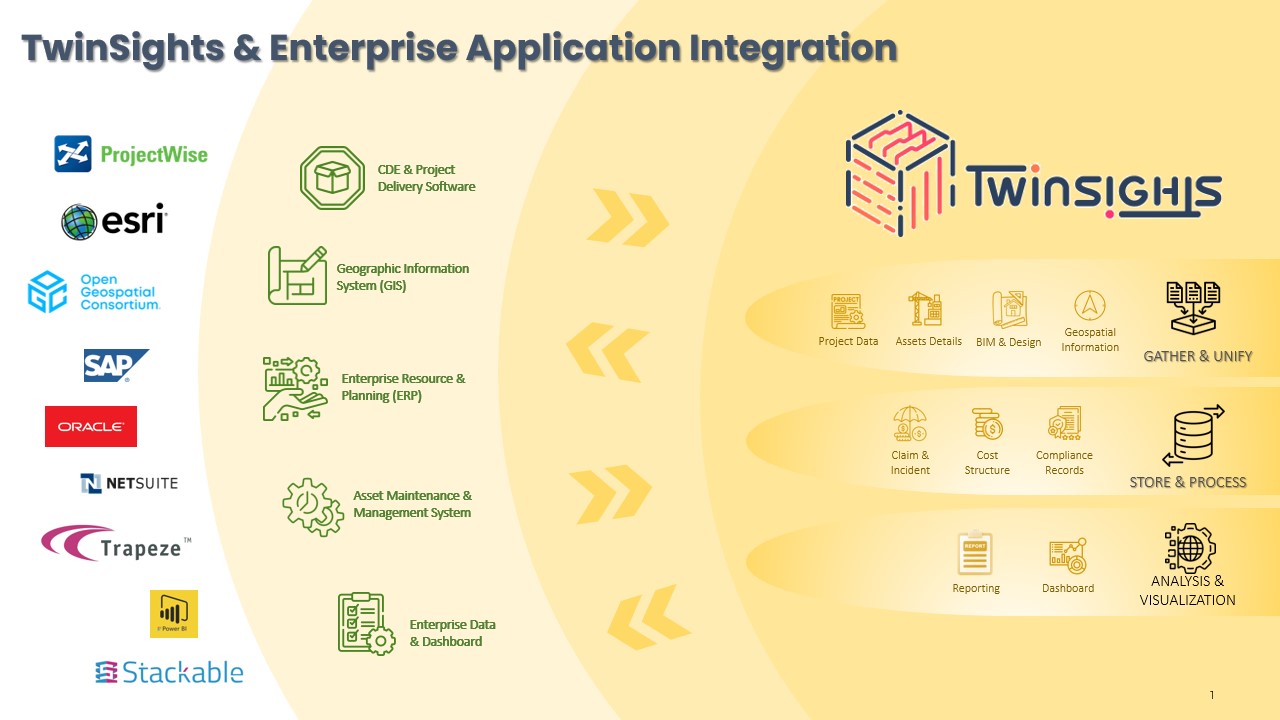
Asset operator organizations are inherently complex. They manage sprawling portfolios of infrastructure, equipment, and facilities, each supported by specialized teams—finance, contracts, operations, maintenance, engineering, and compliance. To keep these functions running, organizations rely on ERP systems as their enterprise backbone, alongside engineering platforms (BIM, GIS), IoT telemetry, and project management tools. 

Asset operators rely on ERP systems as their enterprise backbone, alongside engineering platforms (BIM, GIS), IoT telemetry, and project management tools

Figure:  Asset operators rely on ERP systems as their enterprise backbone, alongside engineering platforms (BIM, GIS), IoT telemetry, and project management tools. 

Each system is powerful, but each is also designed with a departmental lens. Finance optimizes for cost control, operations for uptime, contracts for compliance. The result is a departmentalized environment where processes are optimized locally but fragmented globally. Whenever a business process spans multiple functions—such as acquiring services or managing long‑term agreements—integration becomes essential. 

Without integration, each team works in isolation, duplicating effort and missing opportunities for efficiency. With integration, workflows become seamless, decisions are faster, and the organization operates as one. 

That’s where Twinsights, Digile’s digital twin platform, comes in. 

Why ERP Matters: The Industry Backbone 

ERP platforms are the system of record for most asset operators. They manage contracts, procurement, costs, and compliance, ensuring standardized processes and governance across the enterprise. 

The strength of ERP lies in its centralization and standardization. Once core processes are embedded, organizations gain stability, compliance, and scalability. But ERP systems are not designed to provide immersive visualization, predictive insights, or cross‑departmental orchestration on their own. 

That’s where Twinsights comes in—extending ERP’s transactional power with contextual intelligence. 

Twinsights: The Unified Layer for Asset Operators 

Twinsights delivers powerful enterprise integration capabilities that seamlessly connect data, workflows, and stakeholder collaboration across infrastructure, asset management, and smart city ecosystems. Its platform enables unified operations by bridging technical silos and aligning cross-functional teams throughout the entire lifecycle. 

Enterprise System Integration with Twinsights

Figure:  Enterprise System Integration with Twinsights. 

Twinsights addresses the integration challenge by acting as the digital twin intelligence layer that sits on top of ERP and other enterprise systems. It doesn’t replace ERP—it enhances it, bridging the gap between transactional data and operational intelligence. 

🔗 Unified Data Integration 

  • Connects ERP modules (contracts, costs, maintenance) with engineering, GIS, and IoT data. 
  • Ensures contract managers and cost controllers see the same information in real time. 

🛠️ Cross-Departmental Workflows 

  • Automates processes that span multiple teams, such as contract approvals that trigger cost updates in ERP. 
  • Eliminates manual handovers and ensures consistency across departments. 

🌍 Contextual Visualization & Executive Dashboards 

  • Teams can see how contractual changes affect physical assets, budgets, and schedules in one view. 
  • Leaders gain a holistic view of performance, costs, and risks without waiting for siloed reports. 

Example: Contract and Cost Teams Working Together 

Asset operators deal with large, distributed assets (e.g., power plants, substations, pipelines, treatment plants, meters, etc.). Keeping these assets operational requires a constant flow of spare parts, consumables, and contracted services.  

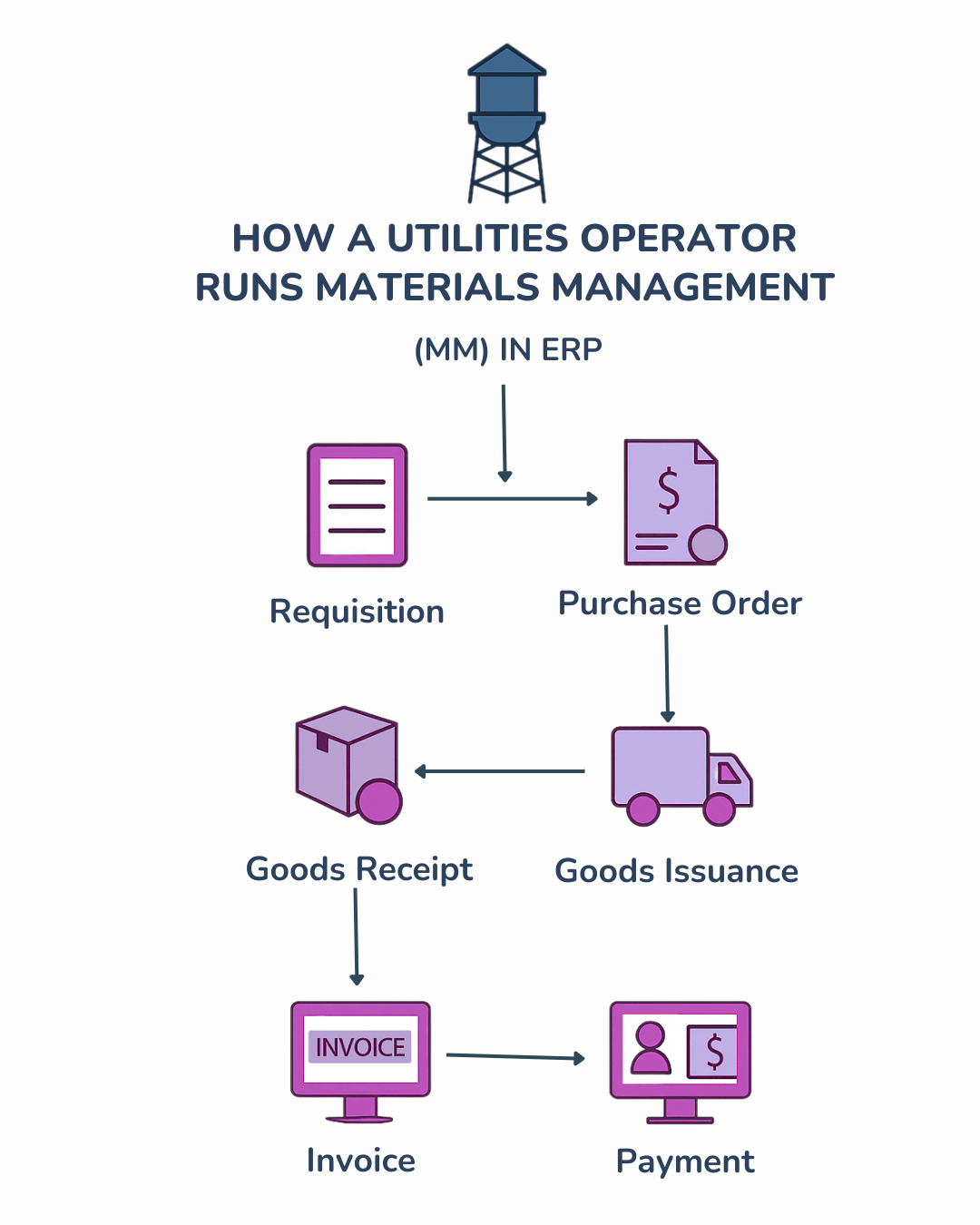
Material management process in ERP for asset operators. 

Figure:  Material management process in ERP for asset operators. 

As illustrated in the diagram above: 

  • Requisition → A maintenance engineer raises a purchase requisition for a spare part or service. 
  • Purchase Order → Procurement converts it into a purchase order with an approved vendor. 
  • Goods Receipt → Materials arrive at the warehouse, and stock is updated in ERP. 
  • Goods Issue → The part is issued to a technician for field work, linked to a work order. 
  • Invoice Verification → Vendor invoice is matched against PO and GR. 
  • Payment → Finance processes payment, with costs allocated to the right cost center 
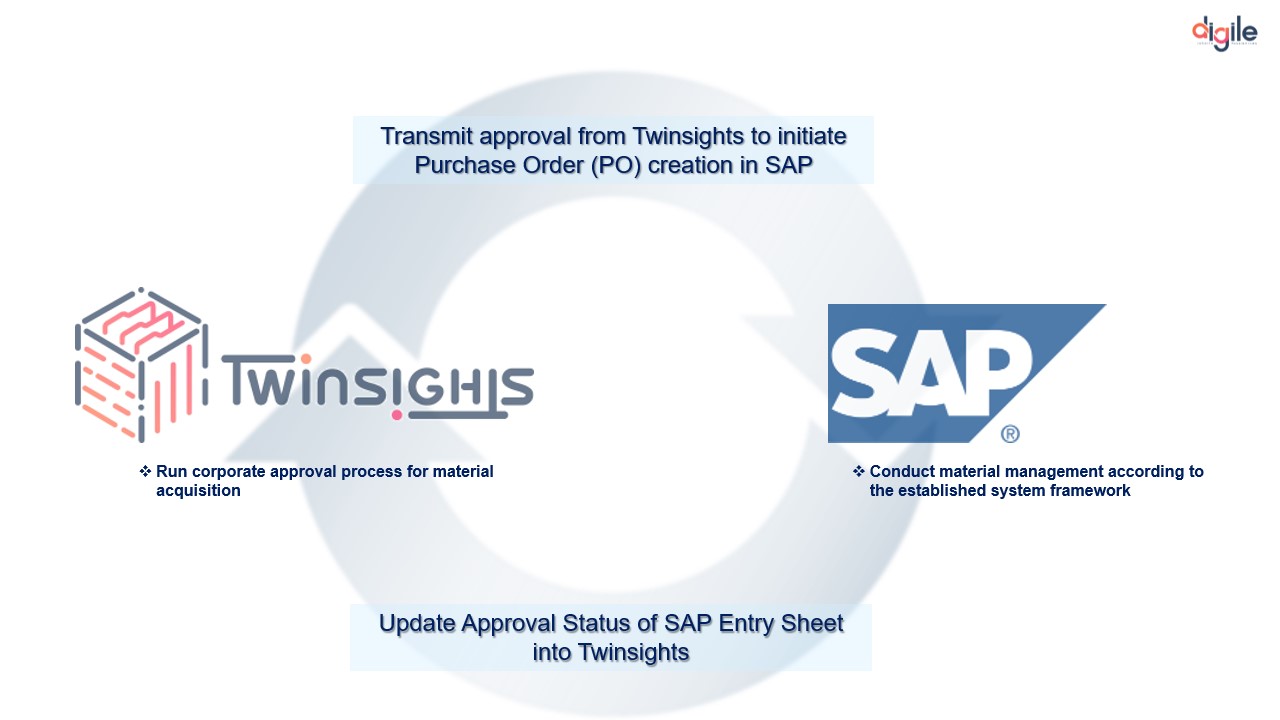
Twinsights and ERP (e.g., SAP) integration for material management process. 

Figure:  Twinsights and ERP (e.g., SAP) integration for material management process. 

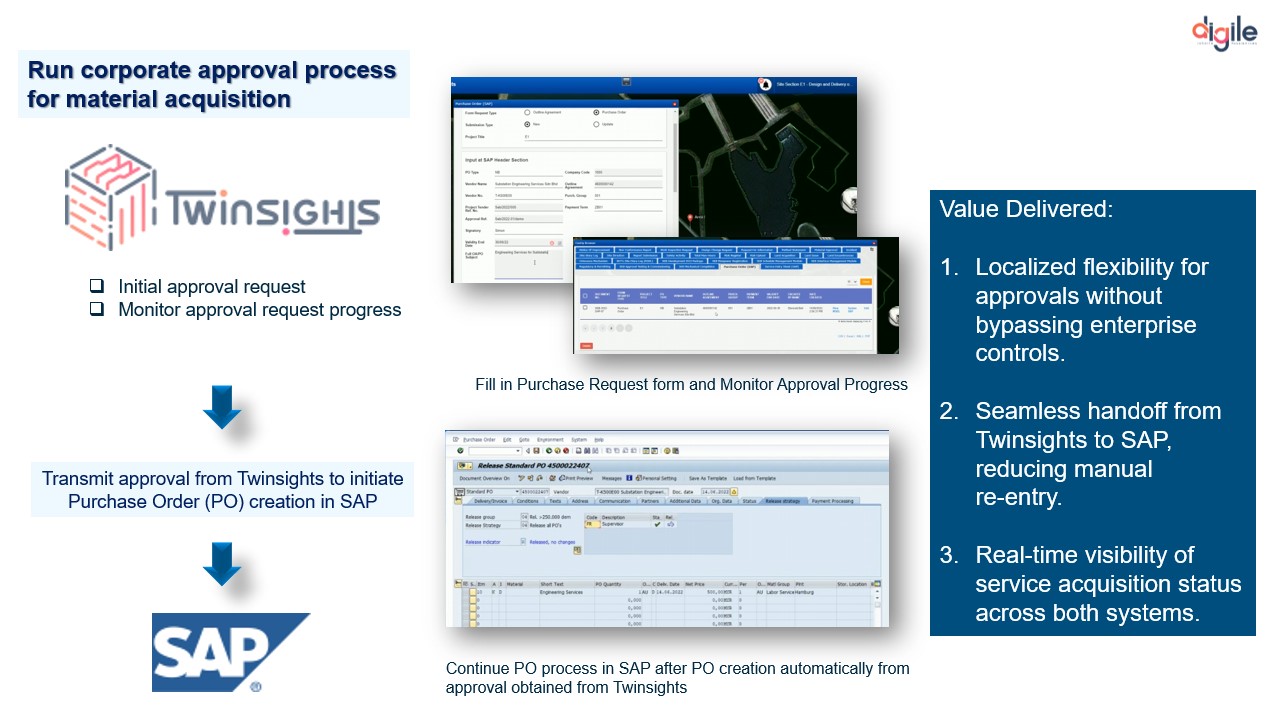
Consider a scenario where an asset operator needs to procure engineering services as part of its routine maintenance operations. Engaging the contractor requires navigating the organization’s established standard operating procedures (SOPs), which often mandate additional approval workflows beyond what the ERP system alone supports. These layered approvals ensure compliance with internal governance and control frameworks before the service request can advance. While Twinsights is designed to integrate with a range of ERP platforms, its deployment alongside SAP serves as the illustrative example in this context, demonstrating how localized approvals in Twinsights can seamlessly trigger downstream procurement actions in the ERP environment. 

Localizing approvals in Twinsights can seamlessly trigger downstream procurement actions in the ERP environment. 

Figure: Localizing approvals in Twinsights can seamlessly trigger downstream procurement actions in the ERP environment. 

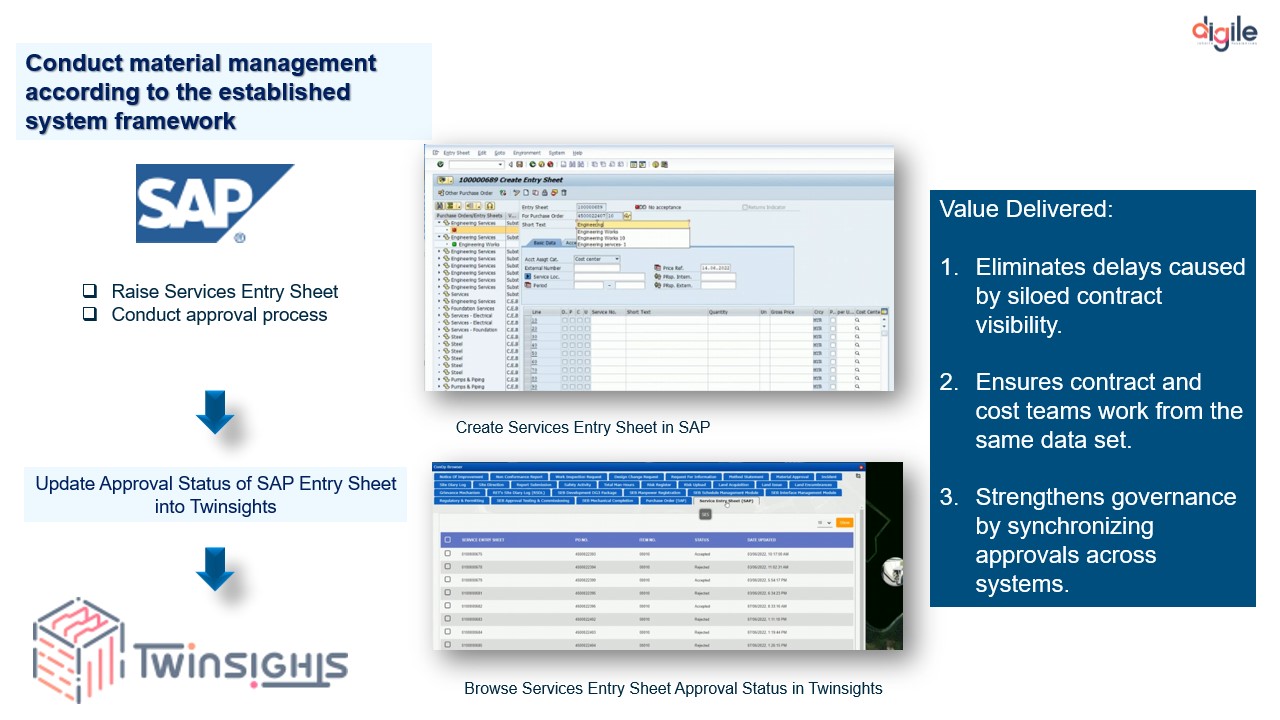
The integration between Twinsights and ERP systems can operate in a bi‑directional manner, ensuring data consistency across platforms. Within the service acquisition process, establishing an Outline Agreement (OA) is a critical step. An OA represents a long‑term purchasing framework between an organization and a vendor, defining agreed terms and conditions for the supply of materials or services over a specified validity period. In practice, it functions as an “umbrella contract” under which multiple purchase orders or scheduled deliveries can be executed. When the OA is created and managed in the ERP system, its approval status and key details can be seamlessly synchronized back into Twinsights through the integration framework, giving stakeholders unified visibility and control 

Material management process in ERP for asset operators. 

Figure:  Material management process in ERP for asset operators. 

With Twinsights, asset operators move beyond simple system connectivity to true organizational alignment. The platform establishes a single source of truth, ensuring that data flows seamlessly across functions. As a result, contract management and cost management teams can collaborate within a unified environment, working from the same information and driving decisions with greater speed, accuracy, and confidence. 

How Digile Enables Success 

As the creator of Twinsights, Digile provides both the platform and the expertise to ensure successful ERP integration: 

  1. ERP Implementation & Rollout – End‑to‑end ERP projects, module configuration, and integration with Twinsights. 
  1. Integration Architecture – Scalable, API‑driven designs leveraging middleware for secure, governed data exchange. 
  1. Process Mapping – Cross‑departmental workflows (service acquisition, agreement management, maintenance‑to‑finance). 
  1. Executive Storytelling – Translating technical integration into ROI and risk‑mitigation narratives. 
  1. User Adoption & Training – Role‑based enablement to ensure teams embrace new workflows. 
  1. Continuous Improvement – Governance frameworks, KPIs, and ESG reporting maturity. 

Conclusion: From Departmental Silos to Unified Operations 

For asset operator organizations, departmentalization is both a strength and a challenge. Specialized teams ensure expertise, but when processes span across functions, integration becomes essential. 

ERP remains the backbone of enterprise operations, trusted by the world’s largest companies because of its stability, scalability, and high switching costs. But to unlock its full potential, organizations need a unifying layer that connects ERP with other systems and aligns departments around shared goals. 

Twinsights provides that layer, enabling contract, cost, and operations teams to collaborate in real time. And with the Digile team’s ERP implementation and integration expertise, organizations can ensure that adoption is not just technically successful, but strategically transformative. 

The result is a shift from fragmented, reactive operations to unified, proactive asset intelligence—where every department contributes to a single, shared vision of success. 

For more updates, follow us on LinkedInTwitterFacebook, and Instagram.

Rewiring the Grid: Digital Transformation in Electric Utility Distribution and the Strategic Role of Twinsights 

Introduction: A Network That Never Sleeps 

The global electric utility distribution network is one of the most expansive and complex infrastructures ever built—spanning an estimated 110 million kilometers of medium- and low-voltage lines. That’s enough to circle the Earth nearly 2,750 times. These networks deliver electricity from substations to homes, industries, and public services, forming the invisible backbone of modern life. As urbanization accelerates and electrification deepens, the pressure on these networks intensifies—not just to expand, but to evolve. 

Yet despite their scale and importance, distribution networks are often managed with fragmented data, aging infrastructure, and reactive maintenance models. The result? Billions in avoidable costs, regulatory friction, and reliability risks. This is where digital transformation becomes not just a strategic opportunity—but an operational necessity. 

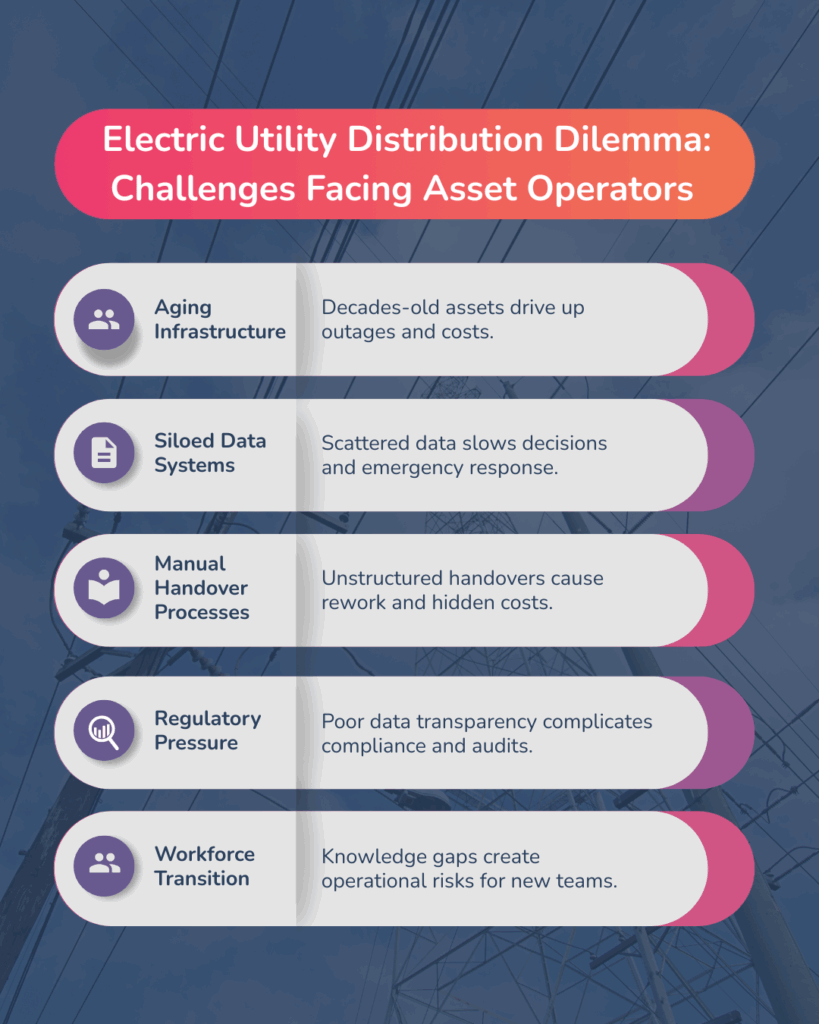
The Distribution Dilemma: Challenges Facing Asset Operators 

 Electric Utility Distribution Dilemma Challenges Facing Asset Operators

Electric utility distribution operators face a unique set of challenges that span technical, financial, and organizational domains: 

1. Aging Infrastructure 

Many assets—transformers, RMUs, underground cables—are decades old and nearing end-of-life. Without predictive insights, utilities rely on reactive maintenance, increasing outage risks and operating costs. 

2. Siloed Data Systems 

Asset data is often scattered across departments and platforms—CAD drawings in one system, GIS data in another, maintenance logs in spreadsheets. This fragmentation undermines decision-making and slows response times. 

3. Manual Handover Processes 

Project delivery handover is frequently treated as a one-time event, not a structured process. Missing documentation, unregistered assets, and poor digital integration lead to months of rework and millions in hidden costs. 

4. Regulatory Pressure 

Utilities must justify capital investments, demonstrate asset integrity, and comply with safety standards. Without transparent, traceable data, rate cases and audits become contentious. 

5. Workforce Transition 

As experienced engineers retire, knowledge gaps widen. New teams inherit assets without historical context, increasing operational risk and training overhead. 

Enter Digitalization: Turning Complexity into Clarity 

Key Benefits of Digitalization 

Figure: Twinsights unifies BIM, GIS, IoT, and maintenance records into a single pane of glass.

Digital transformation offers a powerful antidote to these challenges. By integrating real-time data, geospatial intelligence, and predictive analytics, utilities can shift from reactive to proactive asset management. 

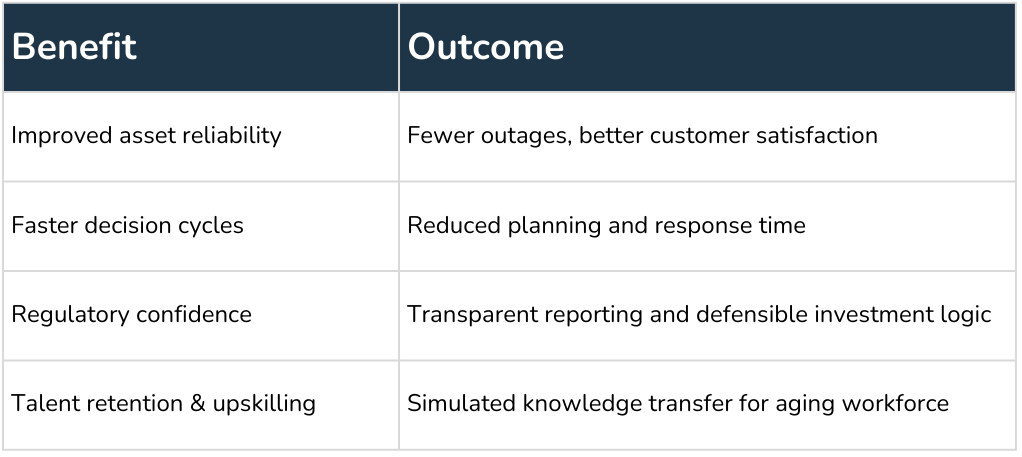
Key Benefits of Digitalization: 

  • Unified Asset Visibility: Combines BIM, GIS, IoT, and maintenance records into a single pane of glass. 
  • Predictive Maintenance: Uses condition monitoring and simulation to forecast failures before they happen. 
  • Faster Decision Cycles: Enables scenario modeling for investment planning and outage mitigation. 
  • Regulatory Confidence: Provides defensible evidence for audits, rate filings, and compliance reviews. 
  • Workforce Enablement: Embeds asset intelligence into intuitive digital environments, reducing onboarding time. 

But digital transformation isn’t just about technology—it’s about strategy, execution, and stakeholder alignment. That’s where platforms like Twinsights and partners like Digile come in. 

Twinsights: The Digital Twin Engine for Asset-Centric Utilities 

Twinsights The Digital Twin Engine for Asset-Centric Utilities

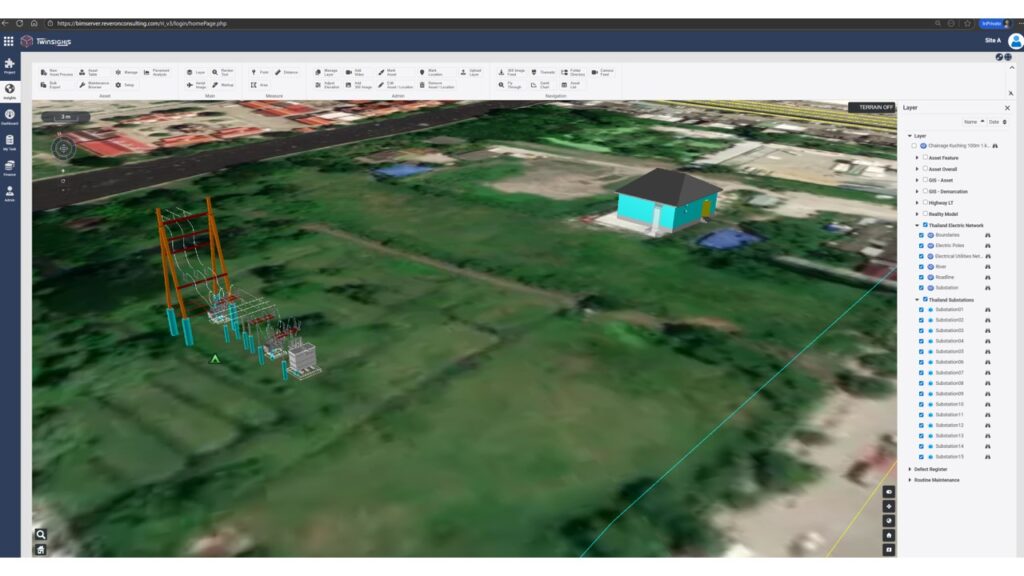
Figure: Twinsights creates immersive 3D/2D environments that mirror real-world assets—substations, RMUs, cable networks—with live telemetry and geospatial overlays.

Twinsights is a next-generation platform purpose-built for infrastructure operators who need to unify technical, financial, and spatial data into a single decision-making environment. 

What Makes Twinsights Different? 

1. Digital Twin Integration 

Twinsights creates immersive 3D/2D environments that mirror real-world assets—substations, RMUs, cable networks—with live telemetry and geospatial overlays. 

2. Automated Workflows 

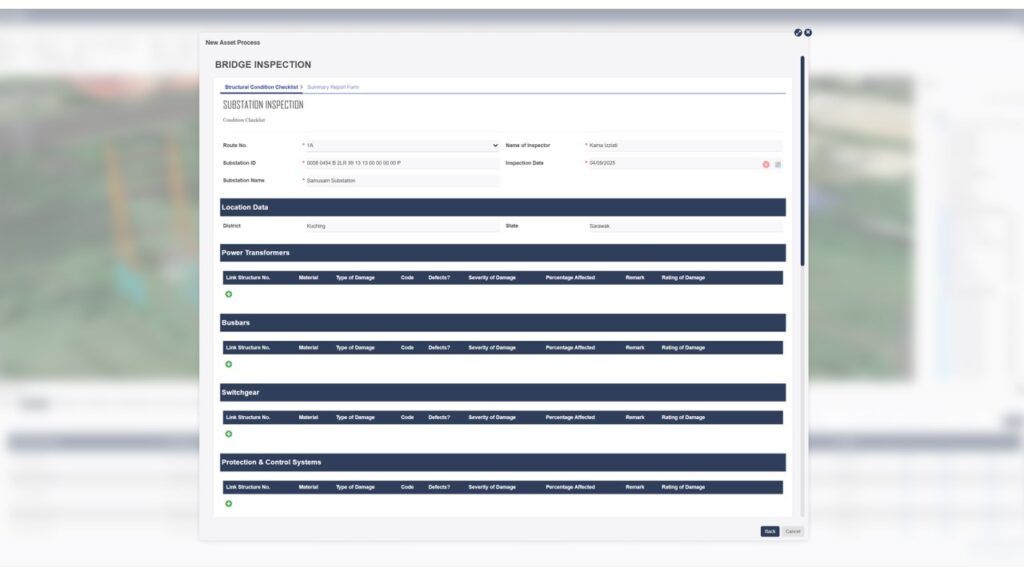
From inspection scheduling to maintenance dispatch, Twinsights streamlines operational processes with pre-built, configurable workflows. 

3. Cross-Stakeholder Collaboration 

Finance, engineering, operations, and regulators can access a shared view of asset health, performance, and investment logic—reducing friction and improving alignment. 

4. Smart Handover Enablement 

Twinsights transforms project delivery handover into a structured, digital-first process. It ingests BIM, CAD, and commissioning data to populate asset registers, GIS platforms, and EAM systems—ensuring assets are ready for operation from day one. 

Strategic Impact for Distribution Operators 

Strategic Impact for Distribution Operators

Twinsights isn’t just a platform—it’s a strategic enabler for utilities navigating the complexity of modern grid operations. 

Strategic Impact for Distribution Operators

Figure: From inspection scheduling to maintenance dispatch, Twinsights streamlines operational processes with pre-built, configurable workflows.

Digile: The Strategic Partner for Digital Transformation 

Technology alone doesn’t deliver transformation. It takes domain expertise, stakeholder engagement, and change management. That’s where Digile plays a critical role. 

How Digile Assists Asset Operators: 

1. Stakeholder Engagement 

From executive briefings to field crew onboarding, Digile ensures that every stakeholder understands the value and functionality of the digital twin ecosystem. 

2. Data Readiness & Integration 

Digile supports the cleansing, structuring, and migration of asset data—ensuring seamless integration into Twinsights and other enterprise platforms. 

3. Handover SOP Reform 

Digile co-develops progressive handover frameworks based on ISO 55000, PAS 1192, and utility-specific AIRs—turning handover into a strategic bridge, not a procedural gap. 

4. Training & Enablement 

Digile delivers tailored training programs that empower teams to use Twinsights effectively—from asset planners to maintenance crews. 

Digile: The Strategic Partner for Digital Transformation

Conclusion: From Grid to Greatness 

The electric utility distribution network is no longer just wires and transformers—it’s a dynamic, data-driven ecosystem. To manage it effectively, operators need more than spreadsheets and legacy systems. They need digital twins, maintenance insights, and strategic partners who understand the complexity of infrastructure transformation. 

Twinsights provides the platform. Digile delivers the strategy. Together, they help utilities move from reactive firefighting to proactive excellence—ensuring that every kilometer of the grid is not just powered but empowered. 

For more updates, follow us on LinkedInTwitterFacebook, and Instagram.

From Recognition to Innovation: Digile’s Journey with Twinsights, Digital Twins & BIM

At Digile, our mission has always centered on pushing the frontiers of infrastructure through digital-first thinking—where BIM, digital twins, and seamless data collaboration shape how projects are planned, delivered, and sustained. We’re proud that this journey earned recognition at Bentley’s prestigious Year in Infrastructure Awards, a global benchmark for excellence in digital project delivery.

A Glimpse Back at the Recognition

Among 571 nominated projects across 60+ countries and 400+ cities, Digile’s work stood out for its ability to combine technical expertise with forward-looking digital practices. Our award in the Road and Rail Asset Performance category, for the Trafficmap Release Two project with Main Roads Western Australia, highlighted how digital tools can transform asset management and deliver real-world benefits to both operators and communities.

This milestone remains an important part of our story—showcasing how innovation, collaboration, and technology can come together to set new standards in infrastructure delivery.

Enter Twinsights: From Projects to Platforms

The recognition also paved the way for broader innovation. Building on the same principles that powered Trafficmap, Digile created Twinsights—our dedicated digital twin platform designed to help organizations gain visibility, control, and insights across the lifecycle of their assets.

With Twinsights, we bring together:

  • BIM and design data integration for seamless collaboration between stakeholders
  • Reality models, sensor data, GIS, and drone inputs to track progress in both 2D and 3D
  • Executive dashboards that highlight performance, flag risks early, and eliminate manual reporting
  • Accessibility and automation, making insights available anywhere, on web or mobile

Just as our award-winning project demonstrated the value of digital asset performance, Twinsights takes that vision further—scaling it into a platform that empowers infrastructure owners, consultants, and contractors worldwide.

Watch the complete video of “The Year in Infrastructure Awards

Why It Matters

This recognition reflects more than a single achievement. It represents a shift:

  • From isolated project delivery to connected, lifecycle-centric approaches
  • From static infrastructure to living, evolving digital assets
  • From fragmented collaboration to unified, data-driven ecosystems

Conclusion

Our recognition at the Year in Infrastructure Awards stands as a testament to Digile’s enduring focus on innovation and excellence. It reflects not just a past achievement, but a continuous journey—driving us to keep advancing BIM, digital twins, and smart engineering practices that will define the future of infrastructure.

For more updates, follow us on LinkedInTwitterFacebook, and Instagram.

Data Governance in Digital Twins: Building Trust and Security

“Data is a precious thing and will last longer than the systems themselves.”
Tim Berners‑Lee, Inventor of the World Wide Web

In an era where infrastructure and asset-intensive industries are rapidly embracing digital transformation, digital twins are emerging as powerful tools for real-time monitoring, predictive analytics, and performance optimization. But the reliability of any digital twin hinges on a single foundation: trusted data.

That trust is built through data governance—a discipline that’s becoming indispensable to organizations looking to scale and sustain their digital twin ecosystems.

What Is Data Governance – Explained

Data governance is a strategic framework that defines how data is collected, managed, protected, and used throughout its lifecycle. It includes:

  • Policies that govern who can access or modify data
  • Processes that ensure data is validated and standardized
  • Technology that supports auditability, compliance, and secure integration

With strong governance, data becomes a valuable, controlled asset that drives smarter decisions and reduces risks.

Why Data Governance Matters for Digital Twins

Digital twins rely on multi-source data inputs from IoT devices, BIM and GIS platforms, ERP systems, and legacy databases. These streams feed into a living, breathing model of physical infrastructure.

Without governance:

  • Data becomes fragmented and inconsistent
  • Models reflect outdated or incorrect realities
  • Stakeholders lose trust in insights and predictions
  • Security and compliance vulnerabilities emerge

According to a 2025 report by ResearchAndMarkets, the global digital twin market is projected to reach USD 154.3 billion by 2030, with data governance cited as a top barrier to adoption due to complexity and integration challenges.
Source: Globenewswire, Digital Twins Strategic Intelligence Report 2025

Key Elements of Effective Data Governance in Digital Twins

To ensure your digital twin is reliable, secure, and scalable, focus on these core pillars:

1. Data Quality and Accuracy

Ensure data is clean and consistent from the start.

  • Real-time validation
  • Cross-platform standardization
  • Automated anomaly detection

2. Data Security and Privacy

Protect sensitive infrastructure data with:

  • Encryption in transit and at rest
  • Role-based access controls
  • Compliance with regulations like GDPR and ISO/IEC 27001

 3. Data Lineage and Transparency

Maintain full traceability of where data originates, how it’s transformed, and how it’s used:

  • Audit trails
  • Version control
  • Visual dependency mapping

 4. Data Lifecycle and Version Control

Govern how data evolves over time:

  • Scheduled updates
  • Change tracking
  • Archival and retention policies

Challenges in Implementing Data Governance for Digital Twins

Despite its importance, many organizations face real-world challenges in deploying data governance effectively:

  • Siloed Data Environments
    Disconnected platforms and departments hinder unified oversight.
  • Interoperability Issues
    Legacy systems, BIM, GIS, and IoT tools often don’t speak the same data language.
  • Lack of Standardized Policies
    Inconsistent formats and unclear data ownership lead to confusion.
  • Manual Data Entry & Errors
    Human processes increase the risk of inconsistencies and delays.
  • Cultural Resistance
    Governance requires a mindset shift—data accountability must span across IT, operations, and leadership.

Overcoming these challenges demands the right platform—and the right partner.

How Twinsights Embeds Governance into Every Digital Twin

At Twinsights, we believe that governance is not an afterthought—it’s a core principle. Our platform is designed to embed data trustworthiness from day one:

Compliance-Ready Architecture

We help clients meet global compliance standards (e.g., GDPR, ISO 27001) with built-in security protocols and audit tools.

Role-Based Access Control and Audit Trails

Access is granted based on user roles, with every interaction logged and traceable.

Unified Data Integration

We seamlessly integrate BIM, GIS, IoT, and enterprise systems—ensuring a single source of truth.

Insightful  Dashboards
Unlock executive-level visibility with real-time insights across every stage of the asset lifecycle. 

  • Instantly track project progress and milestones
  • Receive early alerts to governance or execution risks

With Twinsights, your digital twin becomes a governance-enabling asset—supporting proactive decisions and accountability at every level.

Building Trusted Digital Twins with Twinsights

As digital twins continue to transform how industries plan, operate, and optimize their assets, one truth stands out—data without governance is just noise. For these virtual models to deliver accurate insights and real-world value, trust in the underlying data is essential.

That’s where Twinsights comes in. Our platform is built with governance at its core—empowering organizations to create secure, transparent, and auditable digital twins from day one. From automated data validation to role-based access controls and compliance-ready infrastructure, Twinsights ensures your virtual models are not just intelligent, but trusted.

Because in a world driven by data, a well-governed digital twin isn’t just a tool—it’s a competitive advantage.

Ready to move from digital transformation to trusted transformation? Start with Twinsights.

For more updates, follow us on LinkedInTwitterFacebook, and Instagram.

The Silent Revolution: Reducing Carbon footprint with Digital Twins 

The clock is ticking. With global temperatures shattering records, ice caps receding at alarming rates, and extreme weather events becoming the devastating norm, the imperative for radical climate action has never been clearer. The stark reality outlined by the IPCC demands immediate, large-scale decarbonization across every sector of the global economy. While the challenge is immense, a powerful technological ally is emerging from the digital frontier: the Digital Twin

This isn’t science fiction. Digital twins are rapidly evolving from conceptual buzzwords into indispensable tools for sustainability, offering an unprecedented ability to understand, optimize, and ultimately shrink our collective carbon footprint. They represent a paradigm shift in how we design, build, operate, and manage our physical world, placing sustainability at the core of decision-making. 

What Exactly is a Digital Twin? 

At its essence, a digital twin is a dynamic, virtual replica of a physical asset, process, system, or even an entire environment. It’s far more than a static 3D model. It’s a living, breathing digital counterpart continuously fed by real-time data streams – from sensors (IoT), operational systems, weather feeds, and more. This data fuels sophisticated simulations, powered by artificial intelligence (AI) and machine learning (ML), allowing the digital twin to mirror the behavior, performance, and condition of its physical twin. 

Think of it as a constantly evolving blueprint fused with a crystal ball and a control panel. You can: 

1. Monitor: See exactly what’s happening in the physical system in real-time. 

2. Analyze: Understand performance, identify inefficiencies, and pinpoint energy waste. 

3. Simulate: Test “what-if” scenarios safely in the virtual realm before implementing changes in the real world. 

4. Predict: Forecast future states, potential failures, and maintenance needs. 

5. Optimize: Continuously refine operations for peak efficiency and minimal environmental impact. 

Digital Twins in Action: Key Sectors Leading the Charge 

Energy: Twins model power grids (generation, transmission, distribution), optimizing renewable energy integration (predicting wind/solar output), managing demand response, and preventing outages that lead to inefficient backup generation. 

Manufacturing: Twins replicate entire production lines or factories, simulating processes to minimize energy consumption per unit, optimize machine settings, reduce scrap, and streamline logistics. 

Construction & Buildings: Twins model structures from design through operation, enabling energy-efficient design choices, optimizing construction sequencing to reduce waste and transport, and managing building energy use (HVAC, lighting) in real-time. 

Smart Cities: City-scale twins integrate data from traffic systems, energy grids, water networks, waste management, and buildings, creating a holistic view to optimize urban systems for reduced emissions and resource use. 

How Digital Twins Drive Carbon Reduction: The Core Mechanisms 

1. Real-Time Monitoring & Predictive Maintenance: Slashing Energy Waste 

The constant data flow into a digital twin provides unparalleled visibility. Energy consumption across machines, processes, buildings, or infrastructure is tracked precisely. AI algorithms analyze this data to detect subtle anomalies – a motor drawing slightly more power, an HVAC system operating sub-optimally, or pipeline friction increasing energy needs. Crucially, this enables predictive maintenance. Instead of waiting for failures (which often cause massive energy spikes during emergency repairs or inefficient operation of backup systems), maintenance is performed just in time. This prevents energy-intensive breakdowns, extends asset life (reducing embodied carbon of replacements), and keeps systems running at peak efficiency.  

Result: Significant reductions in avoidable energy waste across the board. 

Example: A global automotive manufacturer uses digital twins for its paint shops, historically massive energy consumers. By monitoring oven temperatures, airflow, and conveyor speeds in real-time and predicting maintenance needs, they reduced energy consumption by 15% per vehicle. 

2. Optimized Resource Utilization: Efficiency from Factory Floor to City Street 

Digital twins excel at finding the most efficient path. In manufacturing, they simulate production schedules, machine settings, and material flows to minimize energy per unit produced and reduce material waste. For supply chains, they model logistics networks, optimizing routes, load consolidation, and warehouse operations to slash transportation emissions (a major global contributor). In building operations, twins integrate with Building Management Systems (BMS), dynamically adjusting heating, cooling, lighting, and ventilation based on occupancy, weather forecasts, and real-time energy prices. In cities, they optimize traffic light sequencing to reduce idling emissions or coordinate waste collection routes. 

Example: Siemens implemented a digital twin for its electronics factory in Amberg, Germany. By simulating and optimizing production processes, energy flows, and logistics within the factory, they achieved a 50% reduction in CO2 emissions per product unit while doubling production volume over a decade.  

Singapore’s “Virtual Singapore” platform uses a city-scale twin to model energy flows, traffic patterns, and microclimates. This has informed policies leading to optimized public transport, targeted building retrofits, and urban heat island mitigation strategies, contributing to the city-state’s ambitious sustainability goals. 

3. Scenario Simulation: Testing Sustainability Strategies Risk-Free 

One of the most powerful capabilities of digital twins is the ability to simulate countless “what-if” scenarios in a risk-free virtual environment. Before investing millions in physical changes, organizations can test the carbon impact of different strategies: 

  • What if we switch this production line to a different energy source? 
  • How will installing rooftop solar panels impact our building’s net energy consumption over the year? 
  • What’s the optimal mix of renewables for our microgrid under different weather conditions? 
  • How would a new traffic management policy affect city-wide emissions? 
  • What if we redesign this product for easier disassembly and recycling? 

These simulations, informed by real-world physics and data, provide quantifiable predictions of carbon savings (or costs), enabling data-driven decisions that maximize sustainability impact and minimize costly missteps.  

Result: Accelerated adoption of low-carbon solutions with proven ROI projections. 

4. Lifecycle Analysis & Sustainable Design: Building Green from the Start 

Digital twins are revolutionizing the design phase. By creating a virtual prototype, engineers and architects can perform comprehensive lifecycle assessments (LCA) before anything is built. The twin can simulate the environmental impact of different materials (embodied carbon), construction methods, operational energy use over decades, and even end-of-life decommissioning or reuse possibilities. This allows for true “design for sustainability” (DfS) or “design for circularity” (DfC). 

Example: A Global engineering firm uses digital twins extensively for sustainable infrastructure projects. For the HS2 high-speed rail project in the UK, they employed digital twins to model different alignment options, station designs, and construction logistics, optimizing for minimal embodied carbon in materials (like low-carbon concrete) and reduced construction emissions. This upfront analysis ensures the project minimizes its carbon footprint across its entire 100+ year lifespan. 

Overcoming Challenges on the Path to Adoption and Carbon Footprint Reduction 

Despite the immense potential, widespread adoption of digital twins for sustainability faces hurdles: 

Data Integration & Silos: Creating a truly effective twin requires aggregating vast, often disparate data sources (OT, IT, IoT, external). Breaking down organizational silos is as crucial as the technology. 

Upfront Investment & ROI Uncertainty: Developing sophisticated twins, especially for complex systems or entire cities, requires significant investment in software, sensors, connectivity, and expertise. Quantifying the precise ROI, particularly for long-term sustainability benefits, can be challenging for budget holders. 

Data Quality & Standardization: The accuracy of a twin is only as good as its data. Ensuring high-quality, consistent, and standardized data feeds is critical. Lack of interoperability standards between different platforms and devices remains an issue. 

Cybersecurity: A highly connected digital replica of critical infrastructure presents a significant attack surface, demanding robust security protocols. 

Skills Gap: Operating and leveraging advanced digital twins requires specialized skills in data science, AI/ML, domain expertise, and systems integration. 

The Future: Digital Twins as a Net Zero Cornerstone 

The trajectory is clear. As sensor networks proliferate (driven by plummeting IoT costs), computational power increases (cloud, edge computing), and AI/ML algorithms become more sophisticated, digital twins will become more powerful, accessible, and affordable. We will see: 

Twin of Twins: Integration of individual asset twins into system-of-systems twins (e.g., a factory twin integrating with the city energy grid twin). 

AI-Driven Autonomous Optimization: Twins evolving beyond simulation to autonomously recommend and even implement optimal settings for minimal carbon output in real-time. 

Democratization: Cloud-based platforms making twin technology accessible to smaller companies and municipalities. 

Enhanced Circularity: Twins tracking materials throughout their lifecycle, enabling true circular economy models. 

Conclusion: From Insight to Action for a Greener, Low-Carbon Future 

The climate crisis demands more than incremental improvements; it requires systemic transformation. Digital twin technology provides the essential toolkit for this transformation. By offering unprecedented visibility, enabling precise optimization, allowing risk-free experimentation, and embedding sustainability into design from the outset, digital twins are moving from being a novel technology to a fundamental infrastructure for achieving Net Zero. 

For companies and governments serious about sustainability, embracing the power of the digital twin is no longer a futuristic option; it’s an operational imperative and a critical step towards building a viable, low-carbon future. The silent revolution in the virtual world is paving the way for profound change in the physical one. The time to twin for sustainability is now. 
 
Twinsights provides an integrated digital twin platform enabling organizations to create unified digital views of assets, processes, and even entire cities. Twinsights emphasizes real-time data consolidation, AI-powered insights, and collaborative workflows – key tools for overcoming implementation barriers. Demonstrated in projects ranging from optimizing the Pan Borneo Highway (yielding significant cost and emissions savings) to simulating sustainable urban management for smart cities, Twinsights exemplifies how scalable digital twin solutions can turn sustainability ambitions into operational realities.  

Follow us on LinkedInTwitterFacebookand Instagram for more updates.
Digital Twins as a Brand Differentiator: Bridging Innovation and Customer Loyalty

Beyond the Hype, Into Strategic Value   

A digital twin is a dynamic, virtual replica of a physical object, system, or process, continuously updated with real-world data from sensors, IoT devices, and user interactions. Unlike static simulations, digital twins enable bidirectional communication: insights from the digital model can drive changes in the physical world, and vice versa.   

Originally confined to industrial applications – like optimizing wind turbines or simulating manufacturing lines – digital twins have evolved into strategic tools for brand differentiation. Forward-thinking companies now leverage them to redefine customer experiences, enhance operational transparency, and amplify sustainability efforts. In crowded markets, where innovation and personalization are critical, digital twins offer a unique edge that transcends efficiency gains – they build emotional connections and trust.   

Why Differentiation Matters: The Battle for Relevance   

Today’s consumers demand more than quality products; they seek hyper-personalized experiences, ethical transparency, and seamless interactions. With 73% of customers prioritizing brands that understand their needs (Accenture Study), differentiation hinges on delivering these expectations at scale. Yet, many brands struggle to innovate beyond superficial tactics like loyalty programs or targeted ads.   

Digital twins bridge this gap by enabling data-driven innovation. They transform abstract customer data into actionable insights, allowing brands to anticipate needs, refine offerings, and project authenticity. For example, a retailer using digital twins to map customer journeys can identify friction points in real time, turning transactional interactions into memorable experiences.   

Key Ways Digital Twins Enable Brand Differentiation   

1. Customer-Centric Innovation: From Prototypes to Perfection  

Digital twins empower brands to test ideas in virtual environments before physical implementation. For instance, automotive companies like BMW use digital twins to simulate vehicle performance under diverse conditions, reducing reliance on costly prototypes. By analyzing real-time driver data, they refine features like adaptive cruise control or battery efficiency, accelerating time-to-market while aligning with customer preferences.   

In retail, brands create digital twins of store layouts to optimize traffic flow or test product placements. This approach minimizes risks and ensures new concepts resonate with target audiences before launch.   

2. Hyper-Personalized Experiences: The Blueprint of Individuality 

Imagine a smart home system that adapts to your habits: lights dimming automatically, thermostats adjusting to your schedule, or security systems learning your routines. Brands like **Siemens** and smart home innovators use digital twins to mirror user environments, enabling such personalization. By simulating individual preferences, companies deliver tailored solutions that feel intuitive—not intrusive.   

In healthcare, digital twins of patients allow providers to predict treatment outcomes. For example, a diabetic patient’s digital twin could simulate glucose responses to different diets, enabling personalized care plans that improve adherence and outcomes.   

3. Operational Transparency and Trust: The Visibility Advantage 

Consumers increasingly value brands that “show their work.” Digital twins enable real-time monitoring of supply chains, manufacturing processes, or product performance. For example, Unilever uses digital twins to track raw materials from source to shelf, ensuring ethical sourcing and reducing waste. This transparency builds trust and loyalty among eco-conscious buyers.   

Predictive maintenance is another trust-builder. In the EV sector, digital twins monitor battery health, alerting drivers to potential issues before failures occur. This proactive approach, exemplified by companies like Rivian, reduces downtime and reinforces reliability.   

4. Sustainability and ESG Impact: Simulating a Greener Future 

Digital twins are pivotal in reducing carbon footprints. Siemens Gamesa, for instance, uses digital twins to optimize wind turbine placement, minimizing ecological disruption while maximizing energy output. By simulating airflow and wear patterns, they extend turbine lifespans and reduce resource waste.   

In fashion, brands like Stella McCartney experiment with digital twins of garments to test designs virtually, slashing fabric waste and water usage. This aligns with ESG goals while appealing to sustainability-driven consumers.   

Case Studies: Digital Twins in Action   

Case 1: BMW’s Software-Defined Differentiation   

BMW leverages digital twins to customize driving experiences. By adjusting software parameters in vehicles – like throttle response or suspension settings – the same hardware can cater to diverse preferences. A 3-Series sedan feels sportier than a 5-Series, despite shared components. This software-driven differentiation maintains brand identity while offering personalization at scale.   

Case 2: PTC’s Automotive Innovation   

PTC’s digital twin solutions enable automakers to simulate autonomous vehicle interactions with urban environments. By testing millions of virtual scenarios – from pedestrian crossings to extreme weather – manufacturers refine safety features without physical trials. This accelerates compliance with regulations and builds consumer confidence in cutting-edge tech.   

Strategic Implementation: Building a Twin-Ready Organization   

Who Benefits?  

Digital twins are not exclusive to tech giants. Mid-sized manufacturers, retailers, and service providers can adopt scaled solutions. Key industries include:   

– Automotive & Aerospace: For R&D and predictive maintenance.   

– Healthcare: To personalize treatments and streamline operations.   

– Retail & CPG: For supply chain optimization and customer journey mapping.   

Tech and Culture Shifts   

Success requires:   

– Data Maturity: Clean, integrated data from IoT, CRM, and ERP systems.   

– Cross-Functional Collaboration: Bridging engineering and marketing teams to align technical capabilities with brand goals.   

– Agile Governance: Modular architectures that adapt to evolving use cases.   

Collaboration Between Teams   

Branding teams must educate engineers on customer pain points, while tech teams demystify digital twin capabilities. Joint workshops and shared KPIs – like customer satisfaction scores or time-to-market – foster alignment.   

Conclusion: From Operational Tool to Strategic Imperative   

Digital twins are no longer just about efficiency – they’re about identity. Brands that harness them to deliver personalized, transparent, and sustainable experiences will dominate their markets. As Siemens Gamesa and BMW demonstrate, the fusion of data and creativity unlocks unparalleled loyalty and differentiation.   

Start small. Identify one customer journey or process to twin. Measure impact, iterate, and scale. The future belongs to brands that dare to mirror their customers’ worlds – then reinvent them.   

Explore All You Need to Know About Digital Twin Technology — how it works, its real-world applications, and why it’s shaping the future of digital innovation.

For more updates, follow us on LinkedInTwitterFacebook, and Instagram.

From Reactive to Predictive: How Digital Twins are Redefining Asset Maintenance 

Asset maintenance has long been the backbone of industrial operations, ensuring machinery, infrastructure, and equipment remain functional. For decades, organizations relied on reactive maintenance – fixing assets only after they break down. While this approach might seem cost-effective in the short term, it often leads to cascading inefficiencies: unplanned downtime, spiraling repair costs, and safety hazards.  

In today’s hyper-competitive landscape, businesses can no longer afford to wait for failures to occur. Enter digital twins – a transformative technology enabling a shift from reactive firefighting to predictive maintenance. By creating virtual replicas of physical assets, organizations can anticipate issues before they arise, optimize performance, and unlock unprecedented levels of operational efficiency. This blog explores how digital twins are revolutionizing asset management and driving industrial transformation.   

The Problem with Reactive Maintenance 

Reactive maintenance, or “run-to-failure” maintenance, operates on a simple principle: if it isn’t broken, don’t fix it. While this approach minimizes upfront costs, its limitations are stark:   

– Unplanned Downtime: Equipment failures halt production unexpectedly, costing manufacturers an estimated $50 billion annually in lost productivity.  (source

– Higher Repair Costs: Emergency fixes often require expedited parts and labor, inflating expenses significantly compared to planned repairs.   

– Safety Risks: Malfunctioning machinery in sectors like oil and gas or chemicals can endanger workers and communities.   

– Asset Degradation: Neglecting early signs of wear shortens asset lifespans, forcing premature replacements.   

For industries reliant on heavy machinery or critical infrastructure, reactive strategies are unsustainable. The shift to proactive methods isn’t just preferable – it’s imperative.   

From Monitoring to Prediction: The Role of Digital Twins in Asset Maintenance 

Traditional monitoring systems collect data via IoT sensors to provide snapshots of asset health. However, this data often sits siloed, offering limited actionable insights. Digital twins elevate this process by creating dynamic, data-driven virtual models that mirror physical assets in real time.   

Powered by IoT, AI, and machine learning, digital twins ingest streams of operational data – temperature, vibration, pressure, and more – to simulate asset behavior under various conditions. This enables two critical advancements:   

1. Real-Time Monitoring: Continuous data updates allow teams to track asset performance minute-by-minute.   

2. Predictive Analytics: By analyzing historical and real-time data, digital twins forecast potential failures, enabling condition-based maintenance.   

For example, a digital twin of a wind turbine can predict bearing wear months in advance, allowing repairs during scheduled downtime rather than amid a storm. This fusion of visibility and foresight transforms maintenance from a guessing game into a science.   

Key Benefits of Predictive Maintenance with Digital Twins 

Adopting digital twins for predictive maintenance delivers measurable advantages:   

1. Reduced Downtime: By anticipating failures, organizations schedule repairs during planned outages, slashing unproductive time by up to 30%. (source)  

2. Cost Savings: Proactive maintenance cuts emergency repair costs and extends asset lifespans, boosting ROI.   

3. Enhanced Safety: Early detection of issues like gas leaks or structural weaknesses mitigates workplace hazards.   

4. Sustainability: Optimized operations reduce energy consumption and waste, aligning with ESG goals.   

These benefits compound over time, fostering resilience and agility in volatile markets.   

Real-World Use Cases   

1. Energy: Wind Turbine Optimization   

Siemens Energy uses digital twins to monitor offshore wind turbines. By simulating stress from wind and waves, the company predicts component fatigue, reducing maintenance visits by 30% and lowering operational costs.   

2. Manufacturing: Assembly Line Precision   

A global automaker integrated digital twins into its production lines. Sensors track motor vibrations, while AI models predict failures. Result? A 25% drop in downtime and a 15% increase in output.   

3. Oil & Gas: Pipeline Integrity   

Shell employs digital twins to monitor pipeline corrosion. Real-time data alerts engineers to risky segments, preventing leaks and ensuring compliance with safety regulations.   

These examples underscore how digital twins drive industrial transformation across sectors.   

Implementing Digital Twins for Maintenance: Considerations & Challenges   

While promising, adopting digital twins requires strategic planning:   

– IoT Infrastructure: Robust sensor networks and connectivity are prerequisites. Legacy systems may need upgrades.   

– Data Quality: Accurate predictions depend on clean, granular data. Incomplete datasets can skew outcomes.   

– Integration: Digital twins must align with existing ERP or CMMS platforms to avoid workflow disruptions.   

– Skill Gaps: Teams need training in data analytics and AI to leverage insights effectively.   

Challenges like upfront costs and data security concerns persist, but scalable cloud solutions and partnerships with tech vendors can ease the transition.   

At Digile, we help you overcome these challenges with a skilled and experienced team of Digital Twins experts who use a combination of industry-leading platforms to deliver practical, high-impact solutions designed around your needs. 

Conclusion 

The era of reactive maintenance is ending. As industries face mounting pressure to optimize costs, ensure safety, and meet sustainability targets, digital twins emerge as a cornerstone of modern asset management. By bridging the gap between physical and digital realms, they empower organizations to predict, prepare, and preempt – transforming maintenance from a cost center into a strategic advantage. For leaders steering digital transformation, the message is clear: the future of maintenance isn’t just about fixing what’s broken. It’s about understanding what could break next and acting before it does. With digital twins, that future is now.   

With Twinsights, you’re equipped to embark on a comprehensive digitalization journey, spanning the entire lifecycle of your infrastructure assets. From overseeing construction projects with greater transparency to optimizing asset performance through real-time insights, Twinsights empowers you to manage infrastructure smarter, safer, and more efficiently. It’s not just a tool – it’s your strategic partner in building resilient, future-ready infrastructure. 

For more updates, follow us on LinkedInTwitterFacebook, and Instagram.

Smarter, Faster Business Decisions with Digital Twins and AI Dashboards

Imagine this: You’re the CEO of a manufacturing company, and one of your critical production lines just ground to a halt. Downtime costs $10,000 per minute. Your team is scrambling—checking sensors, reviewing manuals, and debating solutions. Meanwhile, your competitor across town already diagnosed the problem, simulated a fix in a virtual replica of their factory, and deployed the solution—all before your coffee gets cold.   

This isn’t science fiction. This is the power of digital twins and AI dashboards in action. Together, these technologies are transforming how businesses make decisions, turning guesswork into precision and hindsight into foresight. Let’s dive into how they’re reshaping industries—and why your business can’t afford to ignore them.   

The Digital Twin Revolution: Your Crystal Ball for Business Operations  

A digital twin is exactly what it sounds like: a dynamic, virtual replica of a physical asset, process, or system. Think of it as a “flight simulator” for your business. Whether it’s a wind turbine, a supply chain, or an entire city, a digital twin ingests real-time data from IoT sensors, historical records, and external inputs (like weather or market trends) to create a living, breathing model of your operation.   

But here’s the kicker: Digital twins don’t just mirror reality—they predict it. By running simulations, they answer questions like:   

  • What happens if we increase production speed by 15%?   
  • How will a supplier delay impact next quarter’s output? 
  • Which component will fail next month—and how do we prevent it? 

Take General Electric, for example. They use digital twins to monitor jet engines mid-flight, predicting maintenance needs before a plane even lands. The result? Fewer delays, lower costs, and safer skies.   

The Role of AI Dashboards in Data-Driven Decision-Making 

Now, imagine having a co-pilot who sifts through mountains of data, spots patterns you’d never see, and serves up actionable insights in plain language. That’s an AI dashboard.   

Traditional dashboards show static charts and KPIs. AI dashboards go further:   

Predictive analytics: “Sales in the Indonesia will drop 12% next month due to weather trends. Reroute inventory now.”   

Anomaly detection: “Energy consumption in Building 3 spiked at 2 AM. Possible HVAC malfunction.”   

Prescriptive guidance: “To reduce warehouse bottlenecks, prioritize Supplier B and adjust shift schedules.”   

These tools don’t just report the past – they anticipate the future. Retail giant Amazon uses AI-driven dashboards to optimize delivery routes in real time, saving millions in fuel costs and ensuring your toothpaste arrives before you even realize you’re out.   

How Digital Twins and AI Dashboards Work Together 

On their own, digital twins and AI dashboards are game changers. But combine them, and you unlock a new dimension of decision-making agility. Here’s how:   

1. Real-Time, What-If Scenarios   

Let’s say you’re a pharmaceutical company racing to launch a new drug. Your digital twin simulates production lines, while your AI dashboard cross-references FDA regulations, raw material costs, and global demand. Suddenly, you can test 50 different launch strategies in minutes – without risking a single pill.   

2. Predictive Maintenance on Steroids  

A wind farm operator uses digital twins to model turbine performance. The AI dashboard flags a bearing that’s likely to fail in 6 weeks. Instead of waiting, you order the part, schedule repairs during low-wind season, and avoid $2M in lost energy revenue.   

3. Crisis Management with Confidence   

When a cargo ship blocked the Suez Canal in 2021, global supply chains panicked. Companies using digital twins and AI rerouted shipments, rescheduled production, and balanced inventory before competitors even finished their emergency Zoom calls.   

Why This Duo Beats Traditional Decision-Making 

Old-school decision-making relies on spreadsheets, gut feelings, and post-mortem analyses. It’s like driving while staring at the rearview mirror. Digital twins and AI dashboards flip the script:   

Speed: Decisions happen in hours, not weeks.   

Accuracy: Data-driven insights reduce costly errors.   

Collaboration: Teams align around a single source of truth.   

Innovation: Experiment risk-free in the digital realm.   

A BMW factory manager put it best: “With digital twins, we don’t just solve problems – we prevent them. And with AI, we’re not just reacting; we’re shaping the future.”  

Real-World Applications of Digital Twins and AI Dashboards Across Industries 

Healthcare: Hospitals use digital twins of patient organs to practice surgeries virtually. AI dashboards predict ICU bed shortages during flu season.   

Retail: Nike simulates store layouts digitally to maximize foot traffic. AI adjusts pricing in real time based on competitor moves and inventory levels.   

Energy: Shell’s digital twin of an offshore oil rig cut maintenance costs by 30%. AI optimizes drilling paths to avoid environmental risks.   

Even cities are getting smarter: Singapore’s Virtual Singapore twin helps planners simulate traffic flow, disaster responses, and carbon emissions.   

Case Study: Know how Malaysian Government embraced cutting-edge digital twins through Twinsights. 

Getting Started: How to Pilot These Tools Without Breaking the Bank  

Here’s your playbook:   

1. Identify a pain point: Start small – a single machine, a regional supply chain, or a customer service process.   

2. Build a basic twin: Use existing IoT data and Twinsights to start with a basic model.   

3. Integrate AI insights: Platforms like Microsoft Azure offer plug-and-play analytics.   

4. Scale with success: Use early wins to justify broader investment.   

The Future is Twin-Shaped  

We’re entering an era where every physical asset has a digital shadow, and every leader has an AI advisor. The businesses that thrive will be those who embrace this duo to:   

Anticipate disruptions before they strike.   

Optimize resources with surgical precision.   

Innovate fearlessly in a risk-free digital sandbox.   

So, ask yourself: Is my business still debating spreadsheets—or am I ready to command the future?   

About Twinsights:   

Ready to future-proof your decision-making? Start by mapping one process to a digital twin and explore AI dashboard tools today. The age of intuition-driven leadership is over. The age of intelligence-driven leadership has begun—and it’s smarter, faster, and unstoppable.   

Explore how Twinsights can transform your business with digital twins.  

For more updates, follow us on LinkedInTwitterFacebook, and Instagram.

karmalinks

10 Practical Applications of Digital Twins in Infrastructure 

Digital twin technology has emerged as a cornerstone of modern infrastructure development, enabling real-time monitoring, predictive analytics, and data-driven decision-making. By creating dynamic virtual replicas of physical assets, cities and organizations are revolutionizing how they design, manage, and optimize critical systems. Below are ten groundbreaking applications of digital twins in infrastructure, supported by real-world examples and industry advancements. 

Applications of Digital Twins in Infrastructure

1. Smart Traffic Management 

Digital twins simulate traffic patterns, optimize signal timings, and predict congestion hotspots. For instance, Singapore’s *Virtual Singapore* platform uses real-time data to model vehicle and pedestrian movement, enabling planners to redesign road networks and reduce bottlenecks. Similarly, Helsinki’s 3D+ digital twin analyzes traffic flow to improve public transport efficiency.   

2. Utility System Monitoring 

Water, electricity, and waste management systems are monitored through digital twins to detect leaks, predict outages, and optimize resource distribution. For example, digital twins of power grids simulate energy flows to prevent blackouts, while water networks use sensor data to identify leaks in real time. The UK’s National Grid employs digital twins to balance renewable energy supply and demand, supporting its net-zero goals.   

3. Structural Health Monitoring   

Bridges, highways, and buildings are equipped with IoT sensors that feed data into digital twins, enabling engineers to detect corrosion, stress, or wear. The *Helsinki 3D+* project monitors infrastructure health to prioritize repairs and extend asset lifespans. KPMG reports that such systems reduce maintenance costs by 20% and prevent catastrophic failures.   

4. Urban Development Planning   

City planners use digital twins to visualize the impact of new projects, such as skyscrapers or transit hubs, on existing infrastructure. Singapore’s digital twin evaluates how proposed buildings affect sunlight exposure and wind patterns, ensuring sustainable urban growth. These models also simulate population growth to optimize zoning and resource allocation.   

5. Disaster Preparedness and Response   

Digital twins simulate natural disasters like floods or earthquakes to test evacuation routes and emergency protocols. Singapore’s platform models flood risks from heavy rainfall, while Helsinki uses its twin to coordinate firefighting strategies by providing 3D building layouts to first responders.   

6. Construction Project Lifecycle Management 

From design to maintenance, digital twins streamline construction workflows. BMW’s virtual factories, built using NVIDIA’s Omniverse, allow teams to test assembly line layouts before implementation. Projects like *Virtual Singapore* reduce construction permitting times by 50% through clash detection in virtual models.   

7. Energy Grid Optimization   

Power plants and renewable energy systems leverage digital twins to predict equipment failures and optimize output. Siemens Energy simulates gas turbine performance to boost efficiency by 3.5 MW and cut emissions. Similarly, wind farms use twins to determine ideal turbine placements for maximum energy yield.   

8. Sustainable Urban Design   

Cities integrate environmental data into digital twins to reduce carbon footprints. Helsinki’s twin monitors air quality and green spaces, while Singapore’s model tests policies to lower emissions. These tools also optimize waste management routes, cutting fuel use and pollution.   

9. Public Transportation Networks   

Digital twins model rail, bus, and subway systems to enhance reliability and passenger experience. For example, Helsinki’s twin analyzes commuter behavior to adjust bus schedules, while Singapore optimizes metro routes using real-time ridership data.   

10. Water Distribution and Leak Detection 

Sensors in pipelines feed data into digital twins to detect leaks and predict contamination risks. The *Virtual Singapore* platform maps water networks to prioritize repairs, reducing waste by 15%.   

The Future of Infrastructure: A Digital Twin Revolution   

By 2025, advancements in AI and IoT will make digital twins even more adaptive, enabling autonomous decision-making and deeper sustainability integration. As cities like Singapore and Helsinki demonstrate, this technology is not just a tool – it’s a blueprint for resilient, efficient, and livable urban ecosystems.   

For organizations, the key lies in addressing challenges like data security and interoperability while investing in scalable solutions like Twinsights, simplifying digital twin deployment. The future of infrastructure is digital, and the time to adopt is now.   

Elevate Your Infrastructure Projects with Twinsights 

For organizations seeking to harness the full potential of digital twin technology, platforms like Twinsights offer a game-changing solution. This intuitive platform unifies project, asset, and smart city data into a single interface, enabling real-time collaboration, 3D BIM modeling, and automated workflows. From streamlining mega highway construction in Malaysia to optimizing urban planning processes, Twinsights empowers stakeholders to visualize, analyze, and optimize infrastructure projects at every lifecycle stage. Its integration with GIS, drone surveys, and predictive analytics ensures precision in decision-making while reducing costs and delays. 

Explore how Twinsights can transform your infrastructure initiatives here. 

For more updates, follow us on LinkedInTwitterFacebook, and Instagram.

Digital Twins in Bridge Construction and Maintenance: Transforming Infrastructure for a Smarter Future 

Imagine a future where our bridges do more than just stand—they evolve, adapt, and communicate in real-time. With the advent of digital twin technology, this vision is rapidly becoming a reality. Digital twins create virtual replicas of physical structures, enabling engineers to optimize designs, monitor conditions, and ensure longevity with unparalleled precision. This revolutionary approach is transforming the way we design, construct, and maintain bridges, making infrastructure safer, more efficient, and sustainable. 

Revolutionizing Bridge Construction and Maintenance

Traditional bridge construction relies heavily on physical models and static simulations, which often leave room for errors and inefficiencies. Digital twins, however, bring a dynamic shift by creating an exact virtual replica that can be tested and refined before construction even begins. Engineers can simulate environmental conditions, load-bearing capacities, and potential stress points, allowing for: 

  • Error Reduction: Identifying and mitigating design flaws before construction starts. 
  • Cost Optimization: Precise planning reduces material waste and unnecessary expenses. 
  • Enhanced Collaboration: Stakeholders can visualize and understand project details better, leading to improved decision-making. 

Additionally, digital twins enable iterative design improvements based on simulation outcomes. By running multiple scenarios and stress tests, engineers can select the best materials and construction methods to withstand environmental conditions such as earthquakes, strong winds, and heavy traffic loads. This iterative process fosters greater confidence in the design, leading to fewer surprises during construction. 

Real-Time Monitoring with IoT and Drones 

Once the bridge is constructed, digital twins continue to add value through real-time monitoring. IoT sensors and drones work in tandem to collect critical data on structural health, traffic patterns, and environmental factors. These inputs are fed into the digital twin, providing actionable insights for maintenance teams. Real-time monitoring offers several advantages: 

  • Proactive Maintenance: Sensors detect early signs of wear and tear, allowing teams to address potential issues before they escalate. 
  • Reduced Downtime: Predictive maintenance minimizes disruptions and extends the lifespan of the bridge. 
  • Remote Inspections: Engineers can conduct virtual inspections without needing to be physically present, improving safety and efficiency. 

Drone technology enhances the capabilities of digital twins by capturing high-resolution images and videos of hard-to-reach areas. These images are then analyzed to detect structural anomalies such as cracks, corrosion, or deformation. This proactive approach ensures early intervention, avoiding costly repairs and potential safety hazards. 

Enhancing Collaboration and Project Management 

Digital twins foster an ecosystem of collaboration where every stakeholder—engineers, city planners, and maintenance teams—can access an up-to-date, detailed model of the bridge. This accessibility enhances project coordination and transparency, ensuring: 

  • Efficient Resource Allocation: Data-driven insights help optimize the use of materials and manpower. 
  • Streamlined Decision-Making: A centralized data repository enables quick and informed decisions. 
  • Regulatory Compliance: Ensuring adherence to safety and environmental standards becomes easier with comprehensive, real-time data. 

With cloud-based digital twin platforms, multiple teams across different geographical locations can collaborate seamlessly, accessing the same up-to-date information. This real-time connectivity improves project timelines and ensures all stakeholders are aligned on the bridge’s status and requirements. 

Sustainability and Environmental Impact 

Sustainability is a growing concern in the construction industry, and digital twins offer a compelling solution. By optimizing material usage and monitoring energy consumption, digital twins contribute to greener, more sustainable bridge projects. Key benefits include: 

Reduced Carbon Footprint: Precise planning minimizes construction waste and emissions. 

Energy Efficiency: Monitoring structural components helps identify opportunities for energy savings. 

Lifecycle Optimization: Ensuring longevity reduces the need for frequent reconstructions, conserving resources. 

Digital twins also play a role in optimizing traffic flow on bridges, reducing congestion and emissions. Traffic patterns can be analyzed to implement smart traffic management strategies, such as adaptive lane usage and real-time routing suggestions, further contributing to environmental sustainability. 

Predictive Maintenance with AI Integration 

The integration of  Artificial Intelligence (AI) into digital twins takes predictive maintenance to the next level. AI algorithms analyze patterns in data collected from sensors, predicting potential failures and suggesting optimal maintenance schedules. This smart integration enables: 

  • Automated Alerts: Immediate notifications of potential structural issues. 
  • Data-Driven Insights: Advanced analytics help understand long-term wear and tear patterns. 
  • Autonomous Inspection Systems: The future could see fully automated drones and robots conducting inspections based on AI-generated insights. 

With AI-powered analytics, historical performance data of the bridge can be compared against current conditions, allowing maintenance teams to anticipate potential failures long before they occur. This data-driven approach reduces emergency repairs and extends the service life of bridges significantly. 

Integration with BIM and GIS 

The synergy between digital twins, Building Information Modeling (BIM), and Geographic Information Systems (GIS) provides a holistic approach to infrastructure management. BIM enhances the design and construction phases, while GIS offers spatial data to understand environmental factors better. Together, they enable: 

Comprehensive Project Visualization: Combining 3D models with geographical context. 

Infrastructure Resilience Planning: Preparing for natural disasters or climate change impacts. 

Smart City Integration: Bridges that communicate with other city infrastructure systems. 

BIM integration allows for a detailed representation of every component in the bridge, making future upgrades and renovations more efficient. GIS data, on the other hand, helps in analyzing the bridge’s impact on the surrounding environment, facilitating better urban planning and emergency response strategies. 

Conclusion: A Future Built on Smart Infrastructure 

Digital twins are not just a glimpse into the future—they are actively shaping how we build and maintain bridges today. From extending the lifespan of infrastructure to ensuring public safety and optimizing resources, digital twins provide a transformative solution for bridge construction and maintenance. As this technology continues to evolve, we can expect even smarter, safer, and more sustainable bridges that serve generations to come. 

What’s Next? 

Let us explore other revolutionary aspects or practical applications of digital twins. The journey to smarter infrastructure has just begun, and the potential is limitless. 

For more updates, follow us on LinkedInTwitterFacebook, and Instagram.

Pavement Analysis in 2025: The Road to Smarter Infrastructure

As we step into 2025, the integration of digital tools into infrastructure management is transforming how we analyze, maintain, and optimize roadways. Among the most impactful advancements are platforms designed to enhance pavement analysis, setting new benchmarks for efficiency and precision. With infrastructure becoming more complex and urbanization expanding rapidly, the demand for innovative tools has never been higher. 

Pavement Analysis in the Digital Age 

Traditionally, pavement survey results are presented in static formats such as reports or Excel spreadsheets, often supplemented by basic graphs. While informative, these methods can be cumbersome and lack interactivity. Modern digital tools address this limitation by offering more dynamic and user-friendly approaches. These tools transform raw data into accessible, interactive formats. Users can manipulate the data, apply color-coded settings to highlight key conditions, and visualize pavement health in grids for instant analysis. 

Advanced platforms integrate pavement survey data into GIS maps, highlighting the location and severity of issues. This streamlined visualization enhances maintenance planning and decision-making. 

Why Pavement Analysis Matters in 2025 

  • Critical Infrastructure: Pavements are essential for economic activity, social connectivity, and daily convenience. 
  • Modern Challenges: Aging infrastructure, heavier traffic loads, and climate-induced stresses threaten road durability. 
  • Impact of Poor Roads: Bad conditions disrupt commutes, increase accident risks, and raise costs for logistics and transportation. 
  • Limitations of Traditional Methods: Manual inspections and periodic evaluations are time-consuming, error-prone, and resource-intensive, delaying responses to emerging issues. 
  • Advanced Solutions in 2025: Tools powered by analytics, IoT sensors, and simulations enable real-time monitoring, precise predictions, and efficient road maintenance. 

The Challenges of Traditional Pavement Management 

It is crucial to understand the challenges that have plagued traditional pavement management systems: 

  • Subjective Assessments: Manual inspections often lead to inconsistent evaluations due to human error or varying levels of expertise. 
  • Reactive Maintenance: Repairs are typically initiated only after significant damage is detected, leading to higher costs and longer downtimes. 
  • Limited Data Utilization: Traditional methods rely on limited datasets, which fail to provide a comprehensive view of pavement health. 
  • Inefficient Resource Allocation: Without accurate insights, maintenance budgets are often spent on non-priority areas, leaving critical sections neglected. 

Modern pavement management solutions address these challenges head-on, offering proactive, data-driven approaches that align with the needs of contemporary infrastructure. 

Overcoming Challenges with Pavement Analysis Tools

While the benefits of advanced pavement analysis tools are undeniable, successful implementation requires addressing key challenges: 

  • Data Standardization: Ensuring compatibility between diverse data sources for seamless integration. Stakeholders must establish clear protocols for data collection and sharing. 
  • Stakeholder Collaboration: Fostering cooperation among municipalities, contractors, and technology providers to maximize the potential of new tools. 
  • Training and Adoption: Equipping teams with the skills to leverage advanced features effectively. This includes technical training and change management strategies to ensure smooth adoption. 
  • Initial Investment: While modern tools offer long-term cost savings, the initial investment in technology and infrastructure can be a hurdle for some municipalities. Pilot projects and phased implementations can help mitigate this challenge. 

A Glimpse into the Future of Pavement Management 

In 2025, the potential applications extend far beyond routine pavement maintenance. Here are some potentially transformative use cases: 

  • Dynamic Load Management: Real-time monitoring of load-bearing capacities to guide heavy vehicles along optimal routes, preventing excessive wear and tear. This ensures that roads can handle increasing traffic demands without premature deterioration. 
  • Climate Resilience: Analyzing the impact of temperature fluctuations, flooding, and other climatic factors on pavement performance. Predictive analytics enable cities to design roads that withstand extreme weather conditions. 
  • Smart City Integration: Aligning pavement analysis with broader urban planning goals, such as sustainable mobility and energy-efficient transport systems. 
  • Lifecycle Cost Analysis: Evaluating the long-term costs associated with different materials and maintenance strategies, helping planners make sustainable choices that balance performance and expense. 

Navigating Pavement Analysis with Twinsights 

Traditionally, pavement survey results are presented in static formats such as reports or Excel spreadsheets, often supplemented by basic graphs. While informative, these methods can be cumbersome and lack interactivity. Twinsights addresses this limitation by offering a more dynamic and user-friendly approach. Using a purpose-built tool, it transforms raw data into an accessible, interactive format. Users can manipulate the data, apply color-coded settings to highlight key conditions and visualize pavement health in grids for instant analysis. 

Additionally, Twinsights integrates pavement survey data onto GIS map layers, enhancing the “where” factor. This spatial visualization enables users to understand the exact location and severity of surveyed pavement conditions, streamlining maintenance planning and resource allocation. By making pavement data more actionable and visually intuitive, Twinsights significantly improves decision-making processes. 

Watch a demo video on how the Twinsights Pavement Analysis tool works.

Book a Demo to explore Twinsights Pavement Analysis.

For more updates, follow us on LinkedInTwitterFacebook, and Instagram.

Unlocking Success: Extending GIS for Effective Digital Twin Deployment 

Geographic Information Systems (GIS) play a pivotal role in driving innovation and enhancing decision-making processes across industries. GIS technology has gone beyond mapping and spatial data visualization; it is now a critical component in developing digital twins. As urban environments, industrial systems, and infrastructure projects grow more complex, extending GIS capabilities has become essential for creating accurate, dynamic, and effective digital twins. This blog will delve into the latest advancements in GIS technology, its various applications, and how it serves as a foundation for effective digital twin deployment. 

What is GIS, and How Does it Integrate with Digital Twins? 

Geographic Information Systems (GIS) involve the collection, analysis, and presentation of spatial data. GIS technology allows organizations to visualize data in the context of location and geography, making it easier to identify patterns, relationships, and trends. While traditionally used for mapping and spatial analysis, GIS technology has now expanded its horizons to facilitate the creation of digital twins. 

A digital twin is a virtual representation of a physical entity, process, or system, enabling real-time monitoring, simulation, and analysis. By integrating GIS with digital twins, organizations can achieve a more comprehensive understanding of how geographic factors impact their operations. This fusion allows for better decision-making, predictive modeling, and enhanced control over physical environments. 

Latest Technologies in GIS: Driving Digital Twin Evolution 

The integration of GIS with digital twins is transforming various sectors, from smart cities to infrastructure and industrial operations. To understand how GIS can be extended for effective digital twin deployment, let’s explore some of the latest technological advancements in GIS: 

1. AI-Powered Spatial Analytics 

Artificial Intelligence (AI) and Machine Learning (ML) are revolutionizing GIS by automating spatial data analysis and offering predictive insights. Through AI, GIS can analyze vast amounts of spatial data and uncover hidden patterns and trends that might not be visible to the human eye. This is particularly beneficial for digital twin applications where real-time data feeds can provide proactive alerts for infrastructure issues, environmental changes, and urban development projects. 

2. 3D and 4D GIS Modeling 

Traditional GIS used 2D models for mapping and analysis, but recent advancements have shifted the focus towards 3D and even 4D modeling. 3D GIS creates realistic representations of physical spaces, adding depth and context to spatial data, which is crucial for digital twin simulations. The introduction of the fourth dimension, time, allows digital twins to track changes in the environment over time, enabling better forecasting and decision-making for urban planners and engineers. 

3. Internet of Things (IoT) Integration 

The integration of GIS with IoT sensors allows for real-time data collection from the physical world, which can be seamlessly fed into digital twins. IoT-enabled devices such as smart meters, weather sensors, and environmental monitors continuously gather data on parameters like temperature, humidity, air quality, and energy consumption. This live data feed empowers digital twins to mirror real-world conditions, enabling accurate simulations and predictive analysis. 

4. Cloud-Based GIS Platforms 

Cloud computing has significantly expanded the scalability and accessibility of GIS technology. Cloud-based GIS platforms enable seamless data sharing, collaboration, and integration of spatial data from various sources. With the power of the cloud, digital twin models can handle large datasets, process them quickly, and deliver insights in real-time. This capability is critical for managing large-scale projects like smart city developments, infrastructure planning, and environmental monitoring. 

5. Geospatial Data Interoperability 

Interoperability has become a key focus in extending GIS capabilities for digital twin deployment. Geospatial data often comes from diverse sources, each with its unique format. Advancements in GIS technology now allow for easier integration and standardization of these data formats, ensuring that all components of a digital twin are synchronized and communicate effectively. This enables organizations to create a unified digital representation that accurately reflects their physical assets and environments. 

Applications of GIS in Digital Twin Deployment 

GIS technology has diverse applications in the realm of digital twins, driving innovation across industries. Here are some of the key areas where GIS-enabled digital twins are making a significant impact: 

1. Smart City Planning and Management 

Smart cities are at the forefront of utilizing GIS for digital twin technology. By extending GIS capabilities, city planners can create digital twins of urban environments that offer real-time insights into traffic patterns, infrastructure conditions, and energy consumption. These insights help optimize resource allocation, improve public services, and reduce environmental impacts, making cities more sustainable and resilient. 

2. Infrastructure Monitoring and Maintenance 

For large-scale infrastructure projects like roads, bridges, and utilities, GIS-powered digital twins provide a comprehensive view of the assets. By integrating real-time data from IoT sensors, these digital twins can monitor the structural health of infrastructure, detect anomalies, and predict maintenance needs. This proactive approach helps extend the lifespan of assets and reduces costs associated with unplanned repairs. 

3. Environmental Management and Sustainability 

Environmental management relies heavily on accurate data analysis and forecasting. GIS-enabled digital twins can simulate natural environments, model climate scenarios, and predict the impact of environmental changes. For example, digital twins of ecosystems can help in assessing the effects of deforestation, urban sprawl, and natural disasters, enabling policymakers to implement sustainable practices and develop better mitigation strategies. 

4. Industrial Operations and Asset Management 

In industries such as manufacturing, logistics, and energy, digital twins integrated with GIS technology play a crucial role in asset management. They enable organizations to monitor equipment in real-time, optimize supply chains, and improve production processes. With GIS-based spatial analytics, industries can also identify the best locations for new facilities, reduce operational costs, and enhance productivity. 

5. Disaster Response and Emergency Planning 

One of the most critical applications of GIS in digital twins is in disaster response and emergency planning. By creating digital twins of high-risk areas, emergency response teams can simulate various disaster scenarios, such as floods, wildfires, or earthquakes. This preparation allows for more effective response strategies, reducing casualties and minimizing property damage. 

Benefits of Extending GIS for Digital Twin Deployment 

Integrating GIS into digital twin technology offers a range of benefits that help organizations optimize their operations and make data-driven decisions: 

  • Enhanced Decision-Making: GIS provides a spatial context to data, making it easier to analyze and interpret information, leading to more informed decision-making. 
  • Real-Time Monitoring: The combination of GIS and digital twins enables real-time monitoring of assets and systems, allowing for immediate responses to any issues or anomalies. 
  • Predictive Analytics: With advanced spatial analytics powered by AI, GIS can predict future scenarios, enabling proactive planning and risk mitigation. 
  • Increased Efficiency: GIS-powered digital twins help streamline processes, reduce resource wastage, and improve overall operational efficiency. 
  • Scalability: Cloud-based GIS platforms ensure that digital twin solutions can easily scale to accommodate growing datasets and expanding project requirements. 

The Future of GIS in Digital Twin Deployment 

The future of GIS in digital twin deployment looks promising, with continuous advancements in AI, machine learning, IoT, and big data analytics. As GIS technology evolves, we can expect even more sophisticated digital twins that offer deeper insights and higher accuracy in simulations and forecasting. The combination of these technologies will empower industries to address challenges like climate change, urbanization, and infrastructure development more effectively. 

Moreover, the trend towards open data initiatives and geospatial data sharing will further enhance GIS capabilities, making it easier for organizations to build collaborative and comprehensive digital twins. This will lead to smarter cities, more resilient infrastructure, and sustainable growth across various sectors. 

Conclusion 

Extending GIS capabilities for digital twin deployment is unlocking new possibilities for businesses, governments, and organizations worldwide. By integrating the latest technologies in GIS, such as AI, IoT, and cloud computing, digital twins are becoming more powerful tools for monitoring, analyzing, and optimizing complex systems. The convergence of GIS and digital twins is not just transforming how we visualize and interact with data; it is paving the way for smarter decision-making and sustainable development in the digital age. 

Twinsights, a digital twin platform, offers a comprehensive suite of functionalities to seamlessly connect, consolidate, and strategically manage projects and assets. Our expertise spans the entire digital infrastructure lifecycle, providing solutions for deploying and managing digital twins.

Our approach covers the entire lifecycle, from data integration and system design to predictive analytics and continuous optimization. By leveraging our robust GIS capabilities and end-to-end digital infrastructure approach, Twinsights empowers organizations to maximize operational efficiency, reduce costs, and drive innovation.

Whether you’re looking to build smarter cities, enhance industrial operations, or develop sustainable environmental strategies, Twinsights is designed to help you navigate the complexities of digital transformation. We believe that the integration of GIS into digital twin technology is not just about creating virtual replicas—it’s about unlocking the full potential of your physical assets and systems to achieve long-term success. 

For more updates, follow us on LinkedInTwitterFacebook, and Instagram.

6 Ways of Boosting ROI Using Digital Twin Technology 

In the fast-evolving landscape of Industry 4.0, digital twin technology has emerged as a critical enabler of efficiency, innovation, and, most importantly, return on investment (ROI). While the concept of digital twins—virtual replicas of physical assets—has been around for some time, their application in enhancing ROI with digital twins is now more pronounced due to advances in data analytics, AI, and IoT. Let’s delve into how digital twin technology can be strategically leveraged to boost ROI, focusing on its impact on operational efficiency, predictive maintenance, product development, and asset optimization. 

6 Ways of Boosting ROI Using Digital Twin Technology 

1. Operational Efficiency: Real-Time Insights and Decision-Making 

Digital twins provide real-time insights into the performance of physical assets by continuously monitoring data from sensors, machines, and other IoT devices. This real-time visibility allows organizations to make informed decisions, optimize operations, and reduce downtime—directly impacting ROI. 

Consider a manufacturing plant where digital twins are deployed to monitor and simulate the entire production line. By analysing data in real-time, the digital twin can identify bottlenecks, inefficiencies, and potential failures before they occur. For example, if a machine is operating at suboptimal performance, the digital twin can alert operators to make adjustments, thereby preventing costly breakdowns and ensuring smooth operations. The ability to simulate different scenarios and outcomes also enables management to test and implement changes without disrupting actual production, reducing the risks associated with trial-and-error approaches. 

The ROI boost comes from the reduction in downtime, improved production quality, and the ability to manage inventory levels and produce more with the same resources. This enhanced operational efficiency not only reduces costs but also increases output, directly translating to higher revenue. 

2. Predictive Maintenance: Reducing Unplanned Downtime 

Predictive maintenance is one of the most tangible ways digital twins enhance ROI. Traditional maintenance schedules often lead to unnecessary downtime or, worse, unexpected equipment failures. Digital twins, however, enable predictive maintenance by continuously monitoring asset conditions and predicting when maintenance is needed. 

Technical Implementation: Machine Learning and Predictive Algorithms 

Digital twins integrate with machine learning algorithms that analyze historical and real-time data to predict potential failures. For instance, in an industrial setting, data from vibration sensors, temperature monitors, and other IoT devices are fed into the digital twin. The twin uses this data to model the wear and tear of machinery, identifying patterns that precede failures. 

By implementing predictive maintenance, companies can significantly reduce unplanned downtime. A study by Deloitte found that predictive maintenance can reduce breakdowns by 70%, lower maintenance costs by 25%, and extend the life of aging assets. The ROI from such improvements is substantial, as equipment remains operational for longer periods, maintenance resources are optimized, and production schedules are less likely to be disrupted by unexpected failures. 

3. Product Development: Accelerating Time-to-Market 

Digital twins are revolutionizing product development by enabling virtual prototyping, testing, and iteration. This capability is particularly valuable in industries where physical prototyping is costly and time-consuming, such as aerospace, automotive, and heavy machinery. 

In the product development phase, digital twins allow engineers to create virtual prototypes of products and test them under various conditions before any physical model is built. For example, in the automotive industry, a digital twin of a new engine design can be subjected to virtual stress tests, thermal analysis, and performance simulations. Engineers can tweak the design based on the simulation results, optimizing the product for performance, durability, and cost. 

This process significantly reduces the time and cost associated with physical prototyping. It also shortens the overall product development cycle, allowing companies to bring new products to market faster. The quicker time-to-market not only provides a competitive edge but also accelerates the realization of revenue from new products, thereby boosting ROI. 

4. Asset Optimization: Maximizing Utilization and Performance 

Asset optimization through digital twins involves the continuous monitoring and adjustment of assets to ensure they are operating at peak efficiency. This approach is particularly beneficial in industries with high capital expenditures, such as energy, utilities, and transportation. 

Digital twins utilize optimization algorithms that constantly adjust operational parameters based on real-time data. For instance, in the energy sector, a digital twin of a power plant can optimize the operation of turbines and generators by analyzing data such as fuel consumption, output levels, and environmental conditions. The digital twin can recommend adjustments to improve fuel efficiency, reduce emissions, and maximize energy output. 

Similarly, in transportation, digital twins of fleet vehicles can optimize routes, fuel consumption, and maintenance schedules, ensuring that each vehicle operates at maximum efficiency. This optimization reduces operational costs, extends the lifespan of assets, and improves overall system performance. 

The ROI from asset optimization is multifaceted: lower operational costs, extended asset life, and improved service delivery all contribute to a stronger bottom line. 

5. Enhanced Customer Satisfaction and Retention 

Beyond operational and product development benefits, digital twins also play a crucial role in enhancing customer satisfaction. By providing real-time data and insights, digital twins enable companies to offer better service, faster response times, and more personalized solutions—key factors in customer retention and loyalty. 

For example, in the context of industrial equipment sales, a company that sells heavy machinery can use digital twins to monitor the performance of machines deployed at customer sites. If a machine starts showing signs of potential failure, the company can proactively reach out to the customer to schedule maintenance, thereby preventing downtime for the customer and enhancing their satisfaction. 

This proactive approach not only improves customer relationships but also opens up new revenue streams, such as predictive maintenance services and performance-based contracts. The ROI here is driven by increased customer loyalty, higher lifetime customer value, and additional service revenues

6. Scalability and Flexibility: Adapting to Future Needs 

One of the key advantages of digital twin technology is its scalability and flexibility. As businesses grow and evolve, their operational needs and challenges change. Digital twins are inherently scalable, allowing companies to expand their use across multiple assets, processes, and even entire facilities. 

Modern digital twin platforms are often built on cloud architecture, enabling easy scaling as more data sources and assets are integrated. Additionally, edge computing can be employed to process data locally, reducing latency and enabling real-time decision-making at scale. 

For instance, a global manufacturing enterprise can deploy digital twins across multiple plants, with each plant’s twin feeding data into a centralized system for holistic analysis and optimization. This scalability ensures that the benefits of digital twins—such as improved efficiency, predictive maintenance, and product innovation—are realized across the entire organization, thereby maximizing overall ROI. 

Digital Twin Technology: A Game-Changer for Boosting ROI 

Digital twin technology represents a significant leap forward in how businesses can enhance their ROI. By improving operational efficiency, enabling predictive maintenance, accelerating product development, optimizing asset performance, and enhancing customer satisfaction, digital twins offer a multi-faceted approach to boosting profitability. As this technology continues to evolve, its ability to drive ROI will only grow, making it an essential tool for companies aiming to stay competitive in the digital age. 

Ready to revolutionize your business with Twinsights‘ cutting-edge digital twin technology? Connect with us and explore how boosting ROI using digital twin technology can drive your business growth and streamline your processes.

For more updates, follow us on LinkedInTwitterFacebook, and Instagram.

Oil and Gas Industry is taking big strides with Digital Twins 

The oil and gas industry has always been at the forefront of technological advancements, continually seeking ways to improve efficiency, safety, and profitability. One of the most transformative technologies to emerge in recent years is the concept of digital twins. A digital twin is a virtual replica of a physical asset, system, or process, enabling real-time monitoring, simulation, and analysis. Twinsights, a leading digital twin platform, is at the helm of this revolution, helping oil and gas companies unlock unprecedented capabilities. 

Understanding Digital Twins 

Digital twins are not just static models; they are dynamic and continuously updated with data from their real-world counterparts. This continuous flow of information allows for real-time insights, predictive maintenance, and scenario planning. In the oil and gas sector, where assets are extensive, complex, and often located in remote or hazardous environments, the benefits of digital twins are particularly pronounced. 

How Digital Twin Technology is being used by the Oil & Gas Industry 

Enhancing Operational Efficiency 

One of the primary advantages of digital twins is the enhancement of operational efficiency. Companies like Shell and BP are leveraging digital twins to optimize the performance of their assets. For instance, Shell uses digital twins to monitor and manage its offshore platforms. By integrating data from sensors on equipment such as pumps and compressors, Shell can predict failures before they occur, schedule maintenance more effectively, and reduce unplanned downtime. This not only saves costs but also minimizes the risk of environmental incidents. 

BP, on the other hand, employs digital twins to simulate and optimize its drilling operations. By creating a digital replica of the drilling environment, BP can test different scenarios and strategies without the associated risks and costs of real-world trials. This has led to significant improvements in drilling efficiency and safety, as well as reductions in non-productive time. 

Improving Safety and Compliance 

Safety is paramount in the oil and gas industry, and digital twin technology plays a crucial role in enhancing it. Chevron, for example, has implemented digital twins to improve the safety of its operations. By simulating emergency scenarios and training personnel in a virtual environment, Chevron ensures that its workforce is better prepared for real-world incidents. Additionally, digital twins help Chevron monitor compliance with safety regulations and standards in real-time, identifying potential hazards and ensuring prompt corrective actions. 

In another case, ExxonMobil uses digital twins to enhance the integrity of its pipelines. By continuously monitoring the condition of pipelines and simulating the impact of various stressors, ExxonMobil can predict potential failures and take proactive measures to prevent them. This not only protects the environment and communities but also avoids costly repairs and regulatory fines. 

Facilitating Sustainable Practices 

Due to Climate change and global warming, the oil and gas industry is under increasing pressure to reduce its environmental footprint and adopt more sustainable practices. Digital twins are proving to be invaluable tools in this endeavour. For instance, Total Energies uses digital twins to optimize the performance of its renewable energy assets, such as wind farms and solar plants. By integrating real-time data from these assets, Total Energies can maximize energy production, reduce maintenance costs, and minimize environmental impact. 

Digital twins are also helping companies like Equinor transition to more sustainable operations. Equinor employs digital twins to optimize the performance of its carbon capture and storage (CCS) facilities. By simulating the entire CCS process, from capture to storage, Equinor can identify and address inefficiencies, ensuring that more CO2 is captured and stored safely. This contributes significantly to the company’s goal of reducing greenhouse gas emissions and combating climate change. 

Driving Innovation and Collaboration 

Digital twins are not just about optimizing existing operations; they are also catalysts for innovation and collaboration. By providing a virtual platform where different stakeholders can interact and experiment, digital twins foster the development of new technologies and solutions. For example, Repsol is using digital twins to collaborate with technology partners and startups to develop advanced analytics and AI-driven solutions for reservoir management. This collaborative approach accelerates innovation and helps Repsol stay ahead in the competitive oil and gas market. 

Similarly, digital twins are enabling collaborative efforts to enhance supply chain efficiency. Companies like Petrobras are using digital twins to create a unified view of their supply chain, from exploration to distribution. By integrating data from different stages of the supply chain, Petrobras can optimize logistics, reduce costs, and improve overall efficiency. This collaborative approach also enhances transparency and trust among supply chain partners. 

Shell uses Digital Twin Platform for Deepwater Projects 

Shell’s Deepwater business adopted Bentley’s digital twin platform to enhance its capital projects. This initiative aimed to accelerate project delivery, particularly for subsea tie-back projects, over a decade. Bentley’s iTwin platform offers interoperability and transparency across project and engineering data. The collaboration also involved FutureOn, combining its FieldAP and FieldTwin technologies with Bentley’s platform to advance digital twin technology in the oil and gas industry. Twinsights is a Bentley Partner. 

Final Thoughts 

The oil and gas industry is undergoing a digital transformation, and digital twins are at the heart of this evolution. From enhancing operational efficiency and safety to facilitating sustainable practices and driving innovation, digital twins are unlocking new capabilities and opportunities. Twinsights, with its cutting-edge digital twin platform, can empower oil and gas companies to harness the full potential of this technology and navigate the challenges of the future. 

As the industry continues to evolve, the adoption of digital twins will only accelerate, bringing about even greater efficiencies, safety improvements, and environmental benefits. The future of the oil and gas industry is digital, and digital twins are leading the way. 

Looking to implement digital twins in your organization? Contact the experts at Twinsights and see how they can help you with the process.   

For more updates, follow us on LinkedInTwitterFacebook, and Instagram.

All you need to know about Digital Twin Technology

From companies devising new ways to employ Digital Twins each day to boost efficiency, to NVIDIA creating a Digital Twin of our entire planet to better deal with climate change, it seems like this new technology is being used by almost all industries and all companies across the globe. But what exactly is this Digital Twin Technology, why is everyone obsessed with integrating it into their workflows, and how is it different from the solutions that already exist in the market? In this blog, we will explore everything that you need to know about Digital Twin Technology!

What’s the simplest way to describe Digital Twins?

Digital twin technology is a cutting-edge concept that involves creating virtual replicas of physical objects, processes, or systems. These digital twins are much more than mere static models; they’re dynamic, data-driven representations that mimic the behavior, performance, and characteristics of their real-world counterparts in real-time or near real-time. The concept draws heavily from the fields of the Internet of Things (IoT), artificial intelligence (AI), and data analytics.

At its core, a digital twin consists of three key components: the physical entity (the real-world object or system), the virtual model (its digital counterpart), and the connection or interface that links the two. This connection is crucial as it enables bidirectional communication, allowing the digital twin to receive data from sensors and other sources in the physical world while also influencing or controlling its physical counterpart through actuators or feedback mechanisms.

What is an example of a Digital Twins?

Different applications in various industries would use a variety of Digital Twins to accomplish different goals. For example, in the case of a factory, everything from a conveyor belt system to a goods sorting area could have their digital twins. On the other hand, in the case of a hospital, you could have a digital twin of the operation theater to monitor everyone’s performance, or of the inventory room to keep track of all stock. If Digital Twin technology has such great applications, then why has this technology suddenly taken the world by storm? 

What are the benefits of Digital Twins?

Digital Twins represent a revolutionary technology across various industries, enhancing efficiency, reducing costs, and fostering innovation. Here are the key benefits of Digital Twins:

Improved Operational Efficiency

Digital Twins enable real-time monitoring and management of physical assets by continuously collecting and analyzing data from embedded sensors. This real-time insight helps optimize operations, reduce downtime, and ensure smoother workflows. In manufacturing, for instance, Digital Twins can predict equipment failures before they occur, allowing for proactive maintenance and avoiding costly interruptions.

Enhanced Decision Making

Digital Twins allow for the simulation of different scenarios in a virtual environment before implementing changes in the real world. This reduces risks associated with new initiatives and ensures data-driven decisions. For example, city planners can simulate urban development projects to assess the impact on traffic, utilities, and the environment before actual construction begins.

Cost Reduction

Predicting maintenance needs and avoiding unexpected equipment failures significantly reduces maintenance costs. Additionally, virtual testing of processes and products reduces the need for physical prototypes, saving time and resources. This capability is particularly valuable in industries such as aerospace and automotive.

Improved Product Development

Digital Twins facilitate a better understanding of product performance and customer usage patterns. By simulating real-world conditions, engineers can test new designs under various scenarios, leading to improved product quality and innovation. This feedback loop is invaluable for continuous improvement and tailoring products to meet specific customer needs.

Enhanced Customer Experience

In the real estate sector, for instance, virtual replicas of buildings can provide prospective buyers or tenants with immersive tours, allowing them to explore properties remotely. This improves customer engagement and accelerates the sales process.

Sustainability and Environmental Impact

Digital Twins contribute to sustainability by optimizing resource use and minimizing waste. By simulating different operational scenarios, companies can identify the most efficient ways to use materials and energy. For example, in the energy sector, Digital Twins of power grids can help balance supply and demand more effectively, reducing energy waste and enhancing grid stability.

Safety and Risk Management

In industries such as oil and gas, chemical manufacturing, and mining, Digital Twins monitor hazardous environments and predict potential risks. By simulating dangerous scenarios and planning responses, companies can improve safety protocols and reduce the likelihood of accidents.

Innovation and Competitive Advantage

The insights gained from Digital Twins foster innovation by providing a deeper understanding of systems and processes. Organizations leveraging this technology are better positioned to innovate, stay ahead of competitors, and adapt to changing market conditions. Digital Twins enable continuous improvement and exploration of new business models, driving long-term success.

Digital Twins offer numerous benefits, including operational efficiency, cost reduction, improved decision-making, enhanced product development, better customer experiences, sustainability, safety, and competitive advantage. This technology continues to evolve, transforming how businesses operate and innovate.

For how long have Digital Twins been around?

While the recent popularity might make it seem that Digital Twin Technology is new, this tech has actually been around since the early 2000s. The reason that it has taken so long for it to catch on is that sensors and other technologies needed to capture data have improved dramatically since the early 2000s and their costs have also gone down significantly. Both of these factors have together contributed to the boost of Digital Twin Technologies’ adoption. Now that we understand how Digital Twins became so popular, let’s answer another question that people often have: how do digital twins differ from other technologies such as VR or 3D models?

How are Digital Twins different from other technologies such as VR or 3D models?

Digital twins, Virtual Reality (VR), and 3D models are all immersive technologies, but they serve distinct purposes. Digital twins are virtual replicas of physical objects or systems, incorporating real-time data to simulate their behavior and performance. They are dynamic, updating continuously to reflect changes in their real-world counterparts, and used mainly in industrial settings for predictive maintenance, optimization, and simulation.

In contrast, VR creates entirely synthetic environments, immersing users in computer-generated worlds detached from physical reality. It’s commonly used for entertainment, training, and simulation where real-world constraints can be bypassed. 3D models meanwhile represent physical objects or environments in three dimensions but lack the dynamic, data-driven aspect of digital twins. They are static representations primarily used for visualization, design, and prototyping.

While all three technologies leverage immersive experiences, digital twins uniquely blend real-world data with virtual simulation, distinguishing them from VR’s synthetic environments and 3D models’ static representations.

Do Digital Twins use AI?

Yes, digital twins often use AI to enhance their functionality. AI algorithms process and analyze vast amounts of data from various streams, enabling predictive maintenance, anomaly detection, and performance optimization. Machine learning models can identify patterns, predict future states, and provide insights for decision-making. AI-driven simulations and what-if scenarios help optimize operations and reduce risks. By incorporating AI, digital twins become more dynamic and responsive, accurately reflecting real-time conditions and continuously improving their predictive capabilities. This integration of AI makes digital twins powerful tools for optimizing complex systems and processes.

What are the different types of Digital Twins?

There are several types of digital twins, each serving distinct purposes across different domains.

Component Twins

This is the simplest form of digital twins, representing individual components or parts of a system. They are used to monitor the performance and predict the maintenance needs of specific components. For instance, a digital twin of a jet engine turbine blade can predict wear and tear and suggest timely replacements.

Asset Twins

An asset twin represents a complete asset composed of multiple components. This type of digital twin provides a holistic view of the asset’s performance, operational conditions, and potential issues. For example, an asset twin of an entire jet engine includes all its components, allowing for comprehensive monitoring and analysis.

System Twins

System twins go a step further by simulating entire systems, which may consist of multiple interacting assets. These twins help in understanding the complex interactions within a system, optimizing performance, and ensuring efficient operation. An example is a digital twin of an aircraft, which includes engines, landing gear, avionics, and other systems working together.

Process Twins

These twins focus on the processes and workflows within an organization or system. They are used to simulate and optimize processes such as manufacturing operations, supply chain logistics, and business workflows. A process twin of a manufacturing line can identify bottlenecks, predict delays, and suggest improvements to enhance productivity.

Environmental Twins

These are comprehensive twins that replicate entire environments, often used in smart cities, urban planning, and large-scale industrial operations. They integrate data from numerous sources to model and simulate interactions within an environment, aiding in decision-making for urban development, resource management, and environmental sustainability.

Digital Twins can also be divided into another category set, based on the information on which they are made. 

Data-Driven Digital Twins

These twins rely primarily on data collected from sensors, historical records, and other sources to create and update the digital model. Machine learning and statistical algorithms analyze the data to predict behavior and performance. Data-driven twins are highly effective in identifying patterns, anomalies, and predicting failures based on historical trends. However, they may struggle with scenarios lacking sufficient data or when the system behavior deviates from known patterns.

Physics-Based Digital Twins

These twins are built on the principles of physics and engineering. They use mathematical models to simulate the physical behavior of the system or component under various conditions. Physics-based twins are highly accurate in predicting responses to changes in physical parameters and can simulate scenarios that haven’t been observed before. They require detailed knowledge of the system’s physical properties and are computationally intensive.

Hybrid Digital Twins

These twins combine both data-driven and physics-based approaches. They leverage the strengths of both methods to provide a more robust and comprehensive model. Data-driven insights can fill gaps in physics-based models and vice versa, enhancing predictive accuracy and reliability. Hybrid twins are versatile, and capable of adapting to new data while maintaining a solid foundation in physical principles, making them suitable for complex systems where both data and physical laws are crucial.

Each type of digital twin serves specific needs, from detailed component monitoring to overarching system and process optimization, contributing significantly to enhanced performance, reduced downtime, and better decision-making in various industries.

What are the key requirements of Digital Twins?

Creating Digital Twins that offer all of the key improvements that multinational companies are benefiting from involves several key requirements:

Data Acquisition and Integration

Sensors and IoT Devices – High-quality sensors and IoT devices for real-time data collection.

Data Aggregation Platforms – Platforms to aggregate and synchronize data from various sources.

Modeling and Simulation

Accurate Modeling Tools – Software for creating detailed models of the physical entity.

Simulation Capabilities – Tools for simulating scenarios and predicting outcomes using real-time data and AI algorithms.

Connectivity and Communication

Robust Communication Infrastructure – Reliable networks (e.g., 5G) for continuous data flow.

Interoperability Standards – Standardized protocols and data formats for system compatibility.

Data Management and Storage

Scalable Storage Solutions – Efficient storage for large data volumes.

Data Governance and Security – Policies and measures to ensure data integrity and privacy.

Visualization and Interaction

User-friendly Interfaces – Intuitive tools and dashboards for data interaction and analysis.

AR/VR Integration – Technologies for immersive experiences with the digital twin.

Analytics and Insights

Real-time Analytics – Tools for immediate data processing and insights.

Historical Data Analysis – Capabilities for analyzing trends and informing long-term decisions.

Addressing these requirements enables the creation of effective digital twins, enhancing monitoring, optimization, and predictive maintenance of systems and processes.

What Challenges do Digital Twins solve?

Digital Twins, virtual replicas of physical assets, processes, or systems, address several significant challenges across various industries:

Predictive Maintenance

By continuously monitoring the real-time data of physical assets, Digital Twins can predict potential failures before they occur. This minimizes downtime and extends the lifespan of equipment, resulting in cost savings and improved operational efficiency.

Optimization

Digital Twins allow for the simulation of different scenarios without disrupting actual operations. This helps in optimizing processes, improving resource utilization, and enhancing overall performance. For example, in manufacturing, they can simulate production processes to identify bottlenecks and optimize workflow.

Design and Development

In engineering and product design, Digital Twins facilitate the virtual testing of prototypes, reducing the need for physical prototypes. This accelerates the design cycle, reduces costs, and enhances innovation by allowing engineers to experiment with different designs and materials virtually.

Complex Systems Management

Managing large-scale infrastructure, such as smart cities or industrial plants, becomes more manageable with Digital Twins. They provide a comprehensive view of interconnected systems, enabling better decision-making and efficient management of resources.

Training and Simulation

Digital Twins serve as advanced training tools, allowing personnel to practice and learn in a risk-free virtual environment. This is particularly useful in industries like aerospace, healthcare, and heavy machinery, where training on actual equipment can be dangerous and costly.

Customer Experience

In consumer-facing industries, Digital Twins enhance customer experience by personalizing services and products. For instance, in real estate, virtual tours of properties can be created, offering potential buyers an immersive experience without physical visits.

Overall, Digital Twins bridge the gap between the physical and digital worlds, providing a powerful tool for analysis, prediction, and optimization across multiple sectors.

How do Digital Twins help with Asset Lifecycle?

Digital Twins enhance the asset lifecycle by providing a virtual representation of physical assets, benefiting every phase from design to decommissioning.

Design and Engineering

Simulation and Testing – Virtual testing optimizes designs without physical prototypes.

Collaboration – Ensures clear understanding and better decision-making among stakeholders.

Construction and Commissioning

Project Management – Real-time data tracks progress, predicts delays, and manages resources.

Quality Control – Ensures adherence to design standards, reducing errors and rework.

Operations and Maintenance 

Predictive Maintenance – Continuous monitoring predicts maintenance needs, preventing failures and reducing downtime.

Optimization – Analyzes real-time data to improve efficiency and performance.

Remote Monitoring – Enables monitoring of assets in hard-to-reach or hazardous locations.

End of Life and Decommissioning

Planning – Provides asset condition and history for safer, cost-effective decommissioning.

Recycling and Reuse – Identifies recyclable or reusable components, supporting sustainability.

Continuous Improvement

Feedback Loop – Lifecycle data improves future designs and processes.

Innovation – Scenario simulations foster innovation and efficient asset management.

What data can I input into my Digital Twins?

Digital twins can utilize various data streams, including real-time sensor data (temperature, pressure, humidity), historical data (maintenance records, usage logs), operational data (process metrics, machine status), environmental data (weather conditions, geospatial data), and external data (market trends, regulatory updates). Additionally, they can integrate data from enterprise systems (ERP, CRM), IoT devices, simulation results, and user input. These diverse streams enable digital twins to create accurate, dynamic models of physical assets or systems, facilitating predictive maintenance, performance optimization, and scenario analysis.

Can I Deploy Digital Twins on my server?

Based on preferences, organizations choose to either host their own servers or outsource the hosting and management to a third party either partly or completely. Digital Twins as a tool or service can be deployed to both privately or publicly hosted servers. 

While Digital Twin Technology offers great benefits, ensuring that your organization is actually able to get these advantages requires perfect implementation of the Digital Twin Solution. Twinsights has years of experience in implementing our advanced Digital Twins solutions for our clients so they get to reap all of its benefits. 

Connect with us to explore the possibilities that Digital Twins could open up for our company. 

Follow us on LinkedInTwitterFacebookand Instagram for more updates.
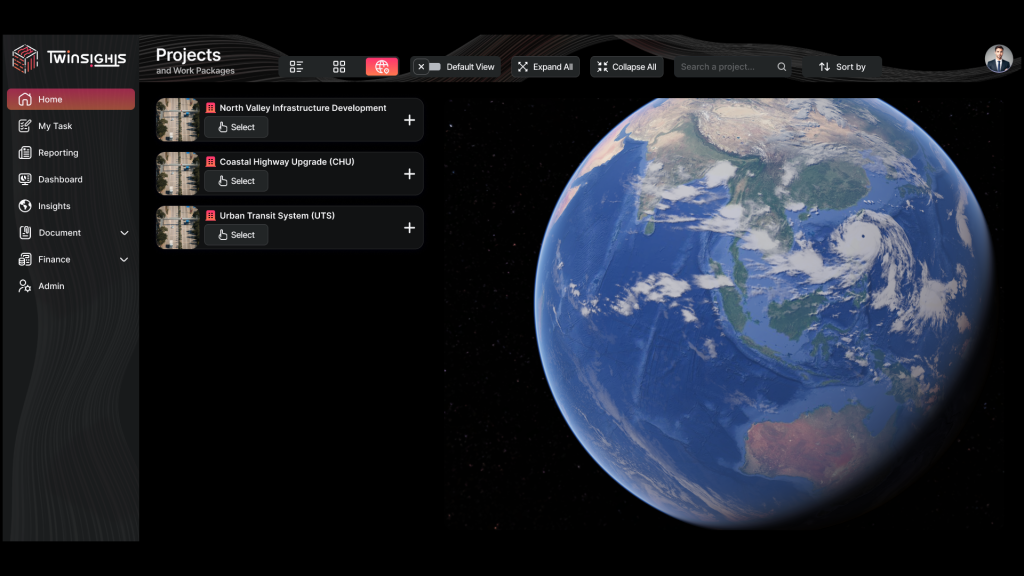
From Vision to Reality: How Digital Twins are Breathing Life into Smart Cities 

The concept of smart cities has evolved significantly over the past decade, driven by advancements in technology and the growing need for more efficient urban management. Among the various innovations propelling this transformation, digital twins stand out as a game-changer. By creating virtual replicas of physical assets, processes, and systems, digital twins enable cities to optimize planning, enhance management, and address urban challenges in real-time.  

Let’s explore how digital twins are turning the vision of smart cities into reality, the global opportunities they present, the development of fit-for-purpose models, and the common requirements for implementing this revolutionary technology. 

In the context of smart cities, digital twins can be used to create detailed models of urban environments. These models allow city planners, engineers, and policymakers to visualize how different components of the city interact, predict potential issues, and optimize operations. From monitoring traffic flow to managing energy consumption, the applications of digital twins in urban management are vast and transformative. 

The Benefits of Digital Twins in City Planning and Management 

Enhanced Decision-Making: Digital twins offer a data-driven approach to city planning. By simulating different scenarios, city planners can make informed decisions about infrastructure development, zoning, and resource allocation. For instance, they can test the impact of a new transportation system or the construction of a high-rise building on traffic and environmental sustainability. 

Predictive Maintenance: Urban infrastructure is prone to wear and tear, often leading to unexpected breakdowns and costly repairs. Digital twins can predict when and where maintenance is needed, allowing city managers to address issues before they escalate. This proactive approach minimizes disruptions, reduces costs, and extends the lifespan of critical infrastructure. 

Efficient Resource Management: Smart cities need to balance resource consumption with sustainability goals. Digital twins enable real-time monitoring of energy use, water supply, and waste management systems. By analyzing this data, cities can optimize resource distribution, reduce waste, and lower their carbon footprint. 

Improved Emergency Response: In the face of natural disasters, accidents, or security threats, quick and coordinated responses are essential. Digital twins can simulate emergency scenarios, helping cities prepare and respond effectively. For example, they can model the impact of a flood on different parts of the city, guiding evacuation plans and resource deployment. 

Citizen Engagement: Digital twins can also be used to engage citizens in the planning process. By providing access to virtual models of proposed developments, residents can visualize changes in their neighborhoods and provide feedback. This transparency fosters trust and collaboration between citizens and city authorities. 

Global Opportunities for Digital Twins in Smart Cities 

The adoption of digital twins is gaining momentum across the globe, with cities in various regions leveraging this technology to achieve their smart city goals. 

Europe: European cities like Copenhagen, Helsinki, and Barcelona are leading the way in integrating digital twins into their urban planning efforts. Copenhagen’s “City Data Exchange” platform uses digital twin technology to monitor energy consumption, traffic, and air quality, enabling the city to achieve its carbon neutrality targets. Helsinki’s 3D city model supports sustainable development and improves the efficiency of city services. 

Asia: In Asia, cities such as Singapore and Shanghai are embracing digital twins to address rapid urbanization and infrastructure challenges. Singapore’s “Virtual Singapore” project is a prime example of how digital twins can be used for comprehensive urban planning. This 3D model of the entire city allows authorities to simulate various scenarios, from crowd management to emergency response, enhancing the city’s resilience. 

North America: In the United States, cities like New York and Las Vegas are utilizing digital twins to optimize urban management and improve public services. Las Vegas, for instance, has developed a digital twin to monitor traffic patterns and reduce congestion. This initiative is part of a broader effort to transform the city into a hub for smart city innovation. 

Middle East: In the Middle East, cities like Dubai and Riyadh are investing in digital twin technology to support their ambitious smart city visions. Dubai’s “Smart Dubai” initiative leverages digital twins to enhance city services, improve sustainability, and ensure seamless connectivity. These efforts are crucial as the region grapples with rapid population growth and environmental challenges. 

A Model for Developing a Fit-for-Purpose Digital Twin 

Creating a digital twin that effectively supports smart city initiatives requires a well-defined model that aligns with the city’s unique needs and goals. The following steps outline a practical approach to developing a fit-for-purpose digital twin: 

Define Objectives: The first step is to identify the specific objectives the digital twin should achieve. These could range from improving traffic management to enhancing energy efficiency or supporting disaster resilience. Clear objectives guide the development process and ensure the digital twin delivers tangible benefits. 

Data Integration: Digital twins rely on data from various sources, including IoT sensors, satellite imagery, and existing databases. Integrating this data into a cohesive model is essential for accuracy and effectiveness. Ensuring data interoperability and quality is a critical aspect of this phase. 

Simulation and Testing: Once the data is integrated, the digital twin can simulate different scenarios to assess its functionality. This testing phase allows for adjustments and fine-tuning to ensure the model accurately reflects the physical world. 

Deployment and Monitoring: After successful testing, the digital twin can be deployed for real-time monitoring and decision-making. Continuous monitoring and updates are necessary to keep the model current and responsive to changing conditions. 

Stakeholder Engagement: Throughout the development process, engaging stakeholders, including government agencies, private sector partners, and citizens, is crucial. Their input ensures the digital twin addresses real-world needs and garners support for its implementation. 

Common Requirements for Implementing Digital Twins 

Implementing digital twin technology in a smart city context requires addressing several common requirements: 

Data Security and Privacy: With the vast amounts of data collected and analyzed by digital twins, ensuring data security and privacy is paramount. Cities must implement robust cybersecurity measures and comply with data protection regulations to safeguard sensitive information. 

Interoperability: Digital twins must be able to integrate with existing city systems and technologies. Ensuring interoperability between different platforms, devices, and data sources is critical for seamless operation. 

Scalability: As cities grow and evolve, their digital twin models must be scalable to accommodate new data and functionalities. A flexible architecture allows for the continuous expansion of the digital twin as new challenges and opportunities arise. 

Collaboration: Developing and maintaining a digital twin requires collaboration between various stakeholders, including government agencies, technology providers, and academia. Establishing strong partnerships is key to the successful implementation and sustainability of the digital twin. 

Twinsights: Pioneering Digital Twin Solutions 

Specializing in creating sophisticated digital twin solutions for smart cities, Twinsights offers a platform that integrates data from various sources to provide a comprehensive view of urban environments. Their solutions enable city planners, engineers, and decision-makers to simulate, analyze, and optimize city operations in real-time. 

Twinsights’ platform is particularly valuable for cities looking to enhance their resource management, predictive maintenance, and emergency response capabilities. By providing tools that support data-driven decision-making, Twinsights helps cities achieve their sustainability and efficiency goals. The platform’s flexibility and scalability also make it an ideal choice for cities of all sizes, from small municipalities to large metropolitan areas. 

Twinsights has worked with several cities to develop digital twins that optimize traffic flow, reduce energy consumption, and improve public services. Their success stories highlight the potential of digital twins to transform urban management and create smarter, more liveable cities. 

Twinsights previously known as Reveron used Digital Twins in Construction of Pan Borneo Highway, Resulting in Massive Cost Savings.  

Digital Twins: The Future of Smart Cities

Digital twins are no longer just a futuristic concept; they are actively shaping the cities of tomorrow. By providing a comprehensive view of urban environments, these virtual replicas enable smarter planning, more efficient management, and better decision-making. As cities around the world embrace this technology, the opportunities for creating sustainable, resilient, and connected urban spaces are immense. However, realizing the full potential of digital twins requires careful planning, collaboration, and a focus on common requirements such as data security, interoperability, and scalability. As we move from vision to reality, digital twins are indeed breathing life into smart cities, making them more liveable, efficient, and responsive to the needs of their inhabitants. 

Looking to implement digital twins? Contact the experts at Twinsights and see how they can help you with the process.   

For more updates, follow us on LinkedInTwitterFacebook, and Instagram.