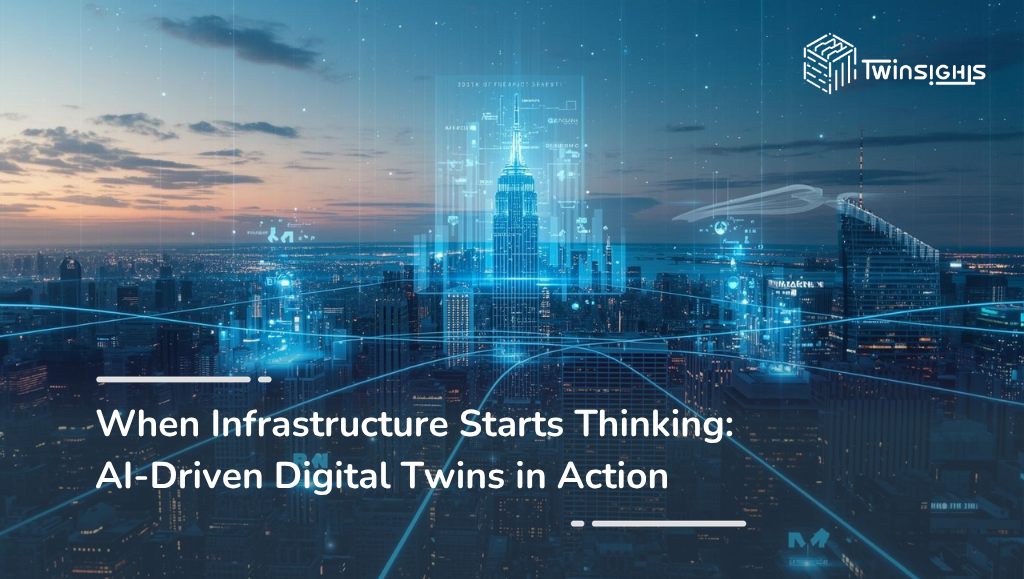
For decades, infrastructure has been built to endure, not to think.
Factories run on schedules. Utilities respond to outages. Supply chains adjust after disruptions. Even the most advanced systems have traditionally been reactive, relying on human intervention to interpret data and make decisions.
That model is changing.
With the rise of AI-driven digital twins, infrastructure is no longer just monitored. It is becoming aware, predictive, and increasingly autonomous. What was once a static representation of assets is now a living system that learns, adapts, and guides decisions in real time.
This shift is not theoretical. It is already happening.
From Representation to Intelligence
A digital twin began as a virtual replica of a physical asset or system. It mirrored machines, processes, or entire environments, providing visibility into performance and condition.
But visibility alone is not enough.
The real transformation happens when AI is layered onto these twins.
Instead of simply showing what is happening, AI-driven twins answer deeper questions:
- What is likely to happen next?
- Why is this deviation occurring?
- What action should be taken right now?
This is where infrastructure starts “thinking.”
Sensors feed continuous data. Systems across the enterprise connect. AI models analyze patterns, detect anomalies, and simulate outcomes. The twin becomes not just a mirror, but a decision engine.
The Power of a Connected Ecosystem
The intelligence of a digital twin depends on how well it is connected.
In most enterprises, operational data is fragmented:
- Shop-floor systems like PLCs and SCADA operate in silos
- Enterprise platforms like ERP and SCM hold business context
- IoT devices generate streams of real-time data
AI-driven digital twins bring these layers together.
When operational technology (OT) and information technology (IT) converge, the twin gains context. It understands not just machine performance, but its impact on production targets, supply chain commitments, and business outcomes.
This convergence enables a shift from isolated optimization to system-wide intelligence.
Enter Twinsights: From Data to Decisions
This is where platforms like Twinsights play a critical role.
Twinsights is designed to move beyond traditional monitoring by creating a unified digital twin environment that connects assets, processes, and enterprise systems into a single intelligent layer.
At its core, Twinsights does three things:
1. Unifies Data Across the Stack
It integrates data from IoT devices, shop-floor systems, and enterprise applications like Oracle Cloud. This creates a single, consistent view of operations.
2. Applies AI for Real-Time Intelligence
AI models analyze streaming and historical data to identify patterns, predict failures, and optimize performance continuously.
3. Enables Action, Not Just Insight
Instead of stopping at dashboards, Twinsights drives recommendations and automated actions, closing the loop between insight and execution.
The result is a system that doesn’t just inform decisions. It actively supports them.
The Twinsights Command Centre: Where It All Comes Together
If Twinsights is the brain, the Twinsights Command Centre is the control room.
It provides a real-time, immersive view of operations across assets, plants, and enterprise systems. But more importantly, it changes how decisions are made.
In a traditional setup:
- Teams monitor dashboards
- Issues are identified manually
- Decisions are escalated and acted upon
In the Twinsights Command Centre:
- Anomalies are detected automatically
- Root causes are suggested instantly
- Scenarios can be simulated before action
- Decisions are executed faster, with confidence
It shifts operations from reactive firefighting to proactive control.
Imagine a manufacturing plant where a slight vibration anomaly is detected in a critical machine. Instead of waiting for failure:
- The system predicts the likelihood of breakdown
- It assesses impact on production schedules
- It recommends optimal maintenance timing
- It aligns with supply chain commitments automatically
All of this happens in near real time.
That is infrastructure thinking.
Real-World Impact Across Industries
AI-driven digital twins are not limited to one sector. Their impact spans multiple industries:
Manufacturing
- Predictive maintenance reduces downtime
- Production lines self-optimize based on demand and constraints
- Quality issues are detected before they escalate
Energy & Utilities
- Grid performance is monitored and optimized dynamically
- Outages are predicted and mitigated proactively
- Renewable integration becomes more stable and efficient
Supply Chain & Logistics
- End-to-end visibility across movement of goods
- Scenario simulation for disruptions
- Real-time optimization of routes and inventory
Smart Infrastructure & Cities
- Traffic systems adapt dynamically
- Infrastructure usage is optimized
- Public services become more responsive
In each case, the shift is the same: from observing systems to orchestrating them.
From Insights to Autonomy
The ultimate promise of AI-driven digital twins is autonomy.
Today, most systems operate in a “human-in-the-loop” model, where AI provides recommendations and humans make decisions.
But as trust in these systems grows, we move toward:
- Human-on-the-loop systems (AI acts, humans supervise)
- Eventually, selective autonomy in controlled environments
This does not eliminate humans. It elevates their role.
Instead of reacting to issues, teams focus on strategy, exceptions, and continuous improvement.
The Challenges to Get There
While the vision is compelling, getting there requires overcoming real challenges:
Data Quality and Integration
Disconnected, inconsistent data can limit the effectiveness of digital twins.
Change Management
Shifting from reactive to AI-driven decision-making requires cultural change.
Trust in AI Systems
Organizations must build confidence in AI recommendations through transparency and governance.
Scalability
Moving from pilot projects to enterprise-wide deployment is often the hardest step.
Platforms like Twinsights address these by providing a structured, scalable foundation for building and operationalizing digital twins across the enterprise.
A New Operating Model for Infrastructure
We are entering a phase where infrastructure is no longer passive.
It senses.
It learns.
It predicts.
It responds.
AI-driven digital twins, powered by platforms like Twinsights and orchestrated through the Twinsights Command Centre, are redefining how enterprises operate.
This is not just about efficiency. It is about control, resilience, and intelligence at scale.
The question is no longer whether infrastructure can think.
It is how quickly organizations are ready to let it.
For more updates, follow us on LinkedIn, Twitter, Facebook, and Instagram.