Asset operator organizations are inherently complex. They manage sprawling portfolios of infrastructure, equipment, and facilities, each supported by specialized teams—finance, contracts, operations, maintenance, engineering, and compliance. To keep these functions running, organizations rely on ERP systems as their enterprise backbone, alongside engineering platforms (BIM, GIS), IoT telemetry, and project management tools.

Figure: Asset operators rely on ERP systems as their enterprise backbone, alongside engineering platforms (BIM, GIS), IoT telemetry, and project management tools.
Each system is powerful, but each is also designed with a departmental lens. Finance optimizes for cost control, operations for uptime, contracts for compliance. The result is a departmentalized environment where processes are optimized locally but fragmented globally. Whenever a business process spans multiple functions—such as acquiring services or managing long‑term agreements—integration becomes essential.
Without integration, each team works in isolation, duplicating effort and missing opportunities for efficiency. With integration, workflows become seamless, decisions are faster, and the organization operates as one.
That’s where Twinsights, Digile’s digital twin platform, comes in.
Why ERP Matters: The Industry Backbone
ERP platforms are the system of record for most asset operators. They manage contracts, procurement, costs, and compliance, ensuring standardized processes and governance across the enterprise.
The strength of ERP lies in its centralization and standardization. Once core processes are embedded, organizations gain stability, compliance, and scalability. But ERP systems are not designed to provide immersive visualization, predictive insights, or cross‑departmental orchestration on their own.
That’s where Twinsights comes in—extending ERP’s transactional power with contextual intelligence.
Twinsights: The Unified Layer for Asset Operators
Twinsights delivers powerful enterprise integration capabilities that seamlessly connect data, workflows, and stakeholder collaboration across infrastructure, asset management, and smart city ecosystems. Its platform enables unified operations by bridging technical silos and aligning cross-functional teams throughout the entire lifecycle.
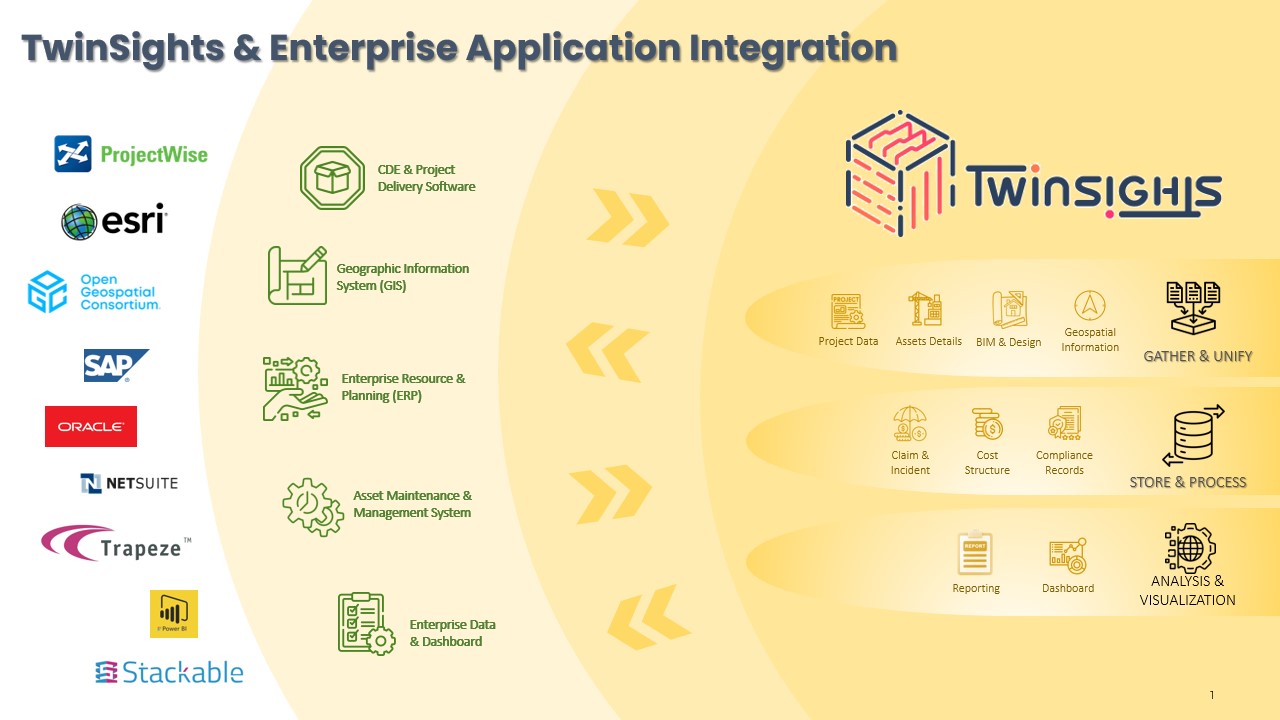
Figure: Enterprise System Integration with Twinsights.
Twinsights addresses the integration challenge by acting as the digital twin intelligence layer that sits on top of ERP and other enterprise systems. It doesn’t replace ERP—it enhances it, bridging the gap between transactional data and operational intelligence.
🔗 Unified Data Integration
- Connects ERP modules (contracts, costs, maintenance) with engineering, GIS, and IoT data.
- Ensures contract managers and cost controllers see the same information in real time.
🛠️ Cross-Departmental Workflows
- Automates processes that span multiple teams, such as contract approvals that trigger cost updates in ERP.
- Eliminates manual handovers and ensures consistency across departments.
🌍 Contextual Visualization & Executive Dashboards
- Teams can see how contractual changes affect physical assets, budgets, and schedules in one view.
- Leaders gain a holistic view of performance, costs, and risks without waiting for siloed reports.
Example: Contract and Cost Teams Working Together
Asset operators deal with large, distributed assets (e.g., power plants, substations, pipelines, treatment plants, meters, etc.). Keeping these assets operational requires a constant flow of spare parts, consumables, and contracted services.
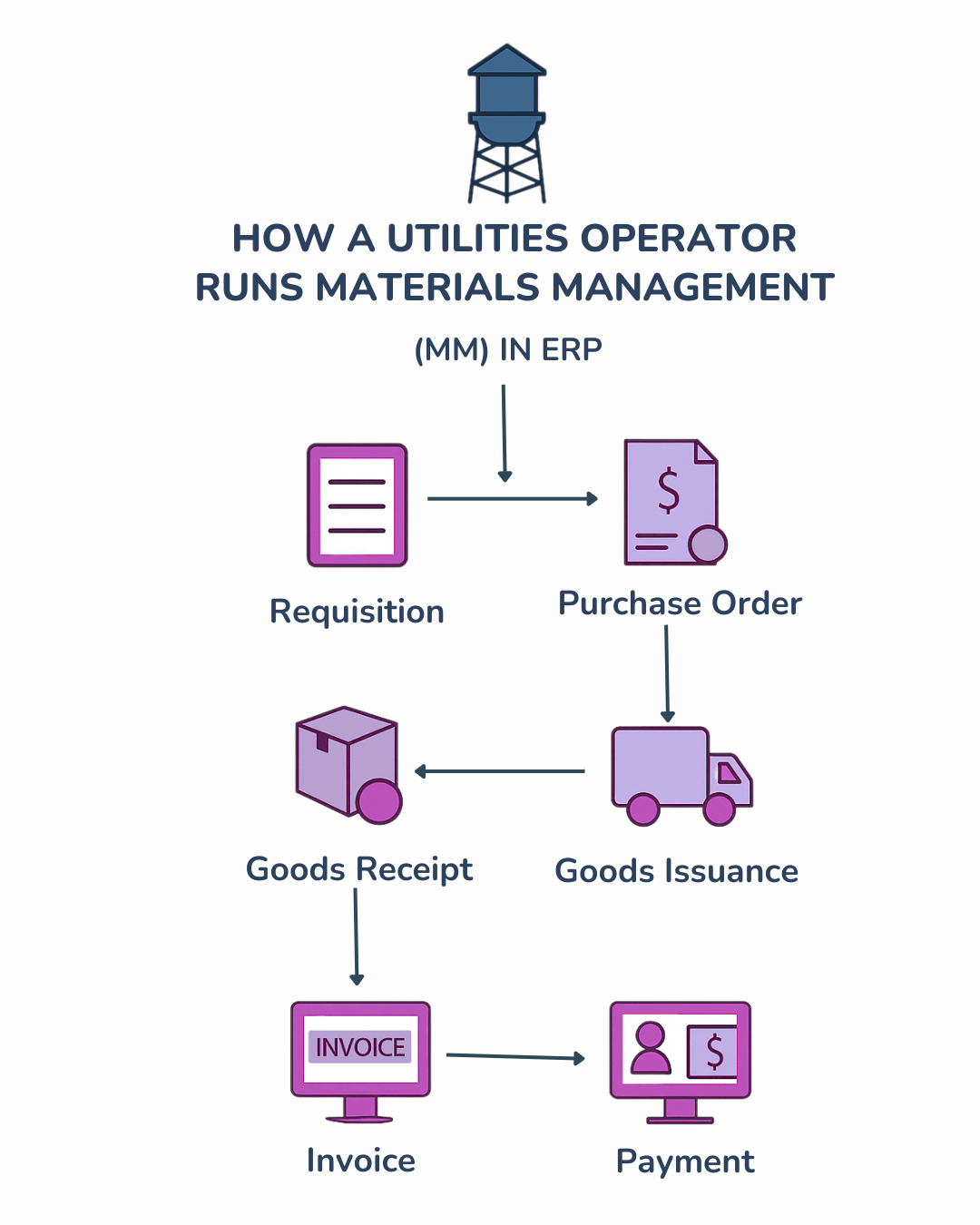
Figure: Material management process in ERP for asset operators.
As illustrated in the diagram above:
- Requisition → A maintenance engineer raises a purchase requisition for a spare part or service.
- Purchase Order → Procurement converts it into a purchase order with an approved vendor.
- Goods Receipt → Materials arrive at the warehouse, and stock is updated in ERP.
- Goods Issue → The part is issued to a technician for field work, linked to a work order.
- Invoice Verification → Vendor invoice is matched against PO and GR.
- Payment → Finance processes payment, with costs allocated to the right cost center
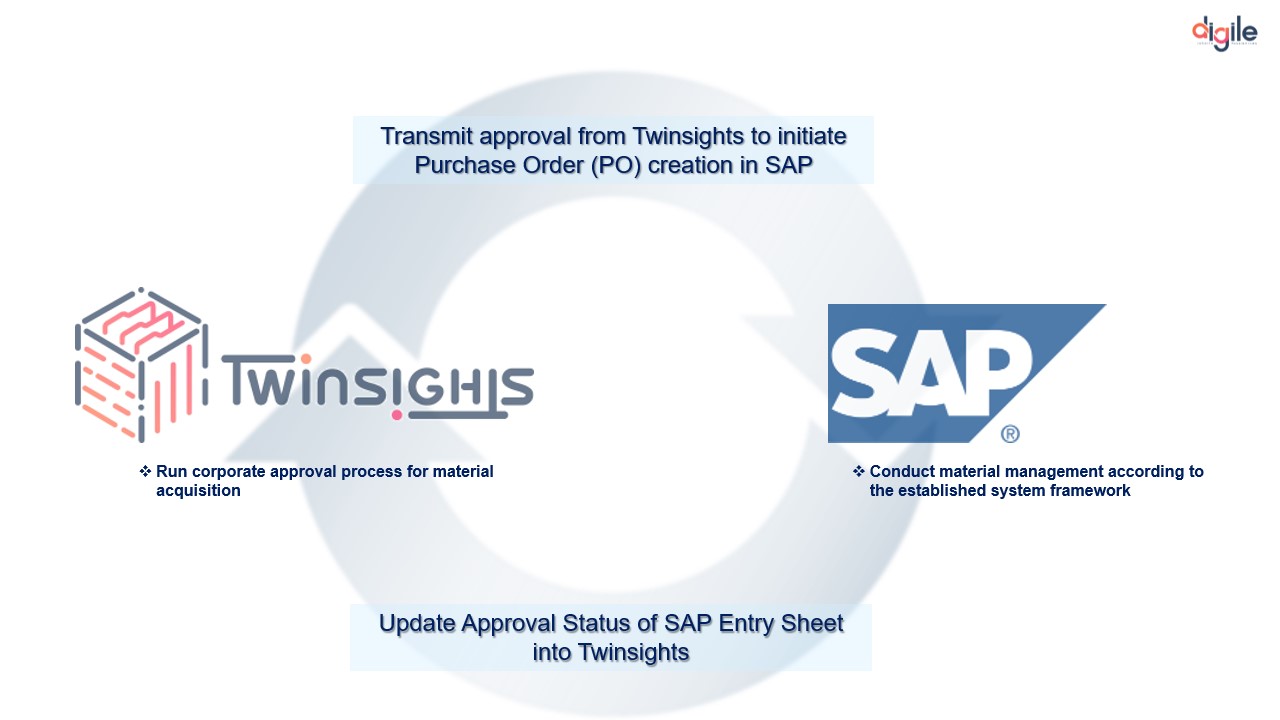
Figure: Twinsights and ERP (e.g., SAP) integration for material management process.
Consider a scenario where an asset operator needs to procure engineering services as part of its routine maintenance operations. Engaging the contractor requires navigating the organization’s established standard operating procedures (SOPs), which often mandate additional approval workflows beyond what the ERP system alone supports. These layered approvals ensure compliance with internal governance and control frameworks before the service request can advance. While Twinsights is designed to integrate with a range of ERP platforms, its deployment alongside SAP serves as the illustrative example in this context, demonstrating how localized approvals in Twinsights can seamlessly trigger downstream procurement actions in the ERP environment.
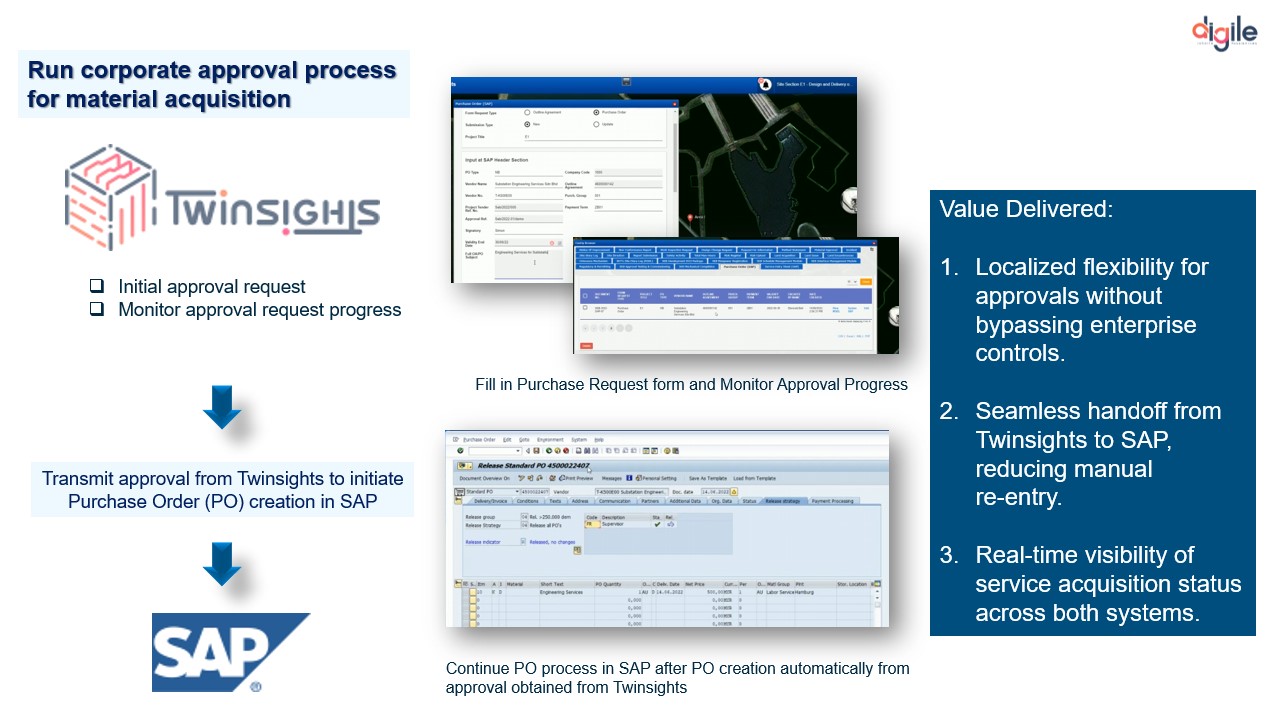
Figure: Localizing approvals in Twinsights can seamlessly trigger downstream procurement actions in the ERP environment.
The integration between Twinsights and ERP systems can operate in a bi‑directional manner, ensuring data consistency across platforms. Within the service acquisition process, establishing an Outline Agreement (OA) is a critical step. An OA represents a long‑term purchasing framework between an organization and a vendor, defining agreed terms and conditions for the supply of materials or services over a specified validity period. In practice, it functions as an “umbrella contract” under which multiple purchase orders or scheduled deliveries can be executed. When the OA is created and managed in the ERP system, its approval status and key details can be seamlessly synchronized back into Twinsights through the integration framework, giving stakeholders unified visibility and control
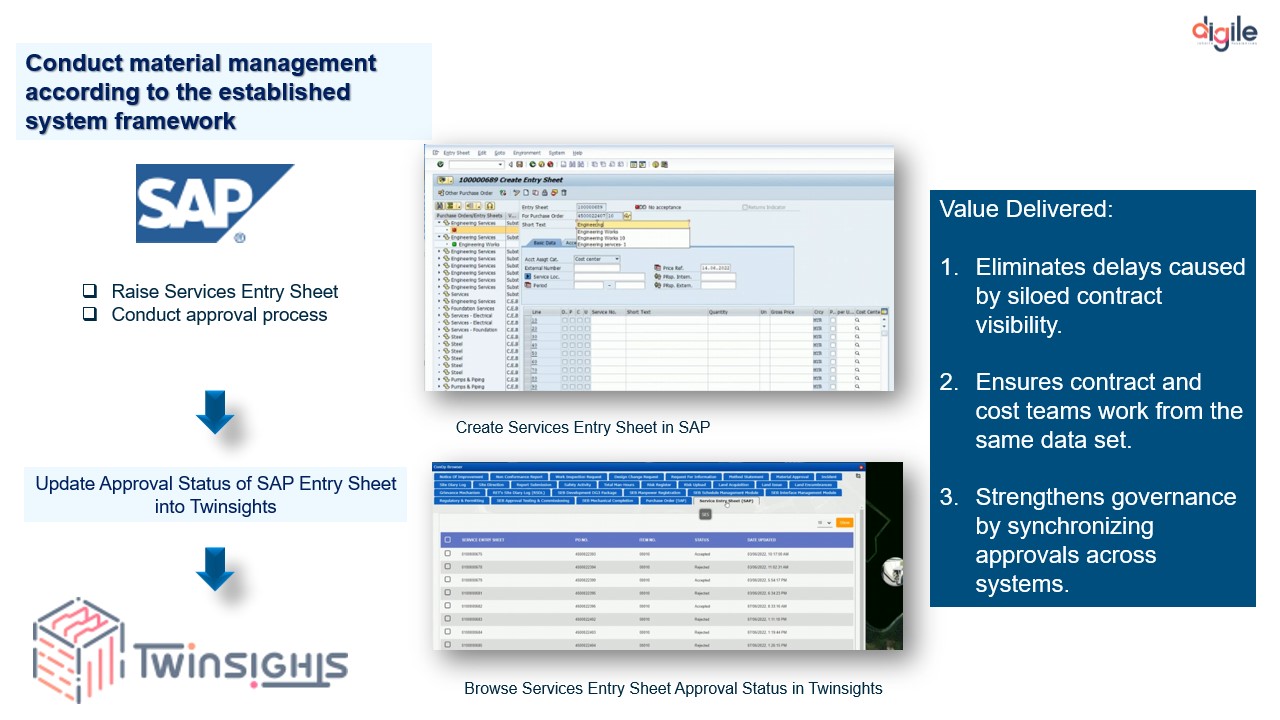
Figure: Material management process in ERP for asset operators.
With Twinsights, asset operators move beyond simple system connectivity to true organizational alignment. The platform establishes a single source of truth, ensuring that data flows seamlessly across functions. As a result, contract management and cost management teams can collaborate within a unified environment, working from the same information and driving decisions with greater speed, accuracy, and confidence.
How Digile Enables Success
As the creator of Twinsights, Digile provides both the platform and the expertise to ensure successful ERP integration:
- ERP Implementation & Rollout – End‑to‑end ERP projects, module configuration, and integration with Twinsights.
- Integration Architecture – Scalable, API‑driven designs leveraging middleware for secure, governed data exchange.
- Process Mapping – Cross‑departmental workflows (service acquisition, agreement management, maintenance‑to‑finance).
- Executive Storytelling – Translating technical integration into ROI and risk‑mitigation narratives.
- User Adoption & Training – Role‑based enablement to ensure teams embrace new workflows.
- Continuous Improvement – Governance frameworks, KPIs, and ESG reporting maturity.
Conclusion: From Departmental Silos to Unified Operations
For asset operator organizations, departmentalization is both a strength and a challenge. Specialized teams ensure expertise, but when processes span across functions, integration becomes essential.
ERP remains the backbone of enterprise operations, trusted by the world’s largest companies because of its stability, scalability, and high switching costs. But to unlock its full potential, organizations need a unifying layer that connects ERP with other systems and aligns departments around shared goals.
Twinsights provides that layer, enabling contract, cost, and operations teams to collaborate in real time. And with the Digile team’s ERP implementation and integration expertise, organizations can ensure that adoption is not just technically successful, but strategically transformative.
The result is a shift from fragmented, reactive operations to unified, proactive asset intelligence—where every department contributes to a single, shared vision of success.
For more updates, follow us on LinkedIn, Twitter, Facebook, and Instagram.